How to Build a Daily Speaking Habit: A Step-by-Step System
Turning daily language speaking into an automatic habit feels tough. We'll show you a simple, step-by-step system to start speaking daily, even if you only have 5 minutes.

Why Is a Daily *Speaking* Habit So Hard to Build?
You’re not alone. With over 1.2 billion people learning a new language worldwide, the journey is a popular one. Yet, so many learners hit the same wall: you can read articles, follow movies, and ace your flashcard app, but when it’s time to speak, you freeze. If this sounds familiar, the problem isn’t your motivation; it’s your method. The key to unlocking fluency lies in understanding how to build a daily language speaking habit, a skill that’s fundamentally different from passive listening or reading. This guide will give you a clear, step-by-step system to move from silent understanding to confident conversation.
The challenge is that we often over-rely on passive skills. While these are important, they can create what a 2026 Lingoda report calls a “false sense of fluency without actual communicative competence.” You absorb information, but you don't build the muscle memory for production. Speaking is a physical, active skill, like playing the piano or shooting a basketball. You can’t learn it just by watching others; you have to get your reps in. Without consistent language speaking, the gap between what you understand and what you can say widens, leading to frustration.
Beyond the mechanics, there are powerful psychological barriers at play. The “intimidation factor” is real. Performance anxiety, the fear of making a mistake, or the worry of being judged can stop you before you even start. This is especially true for learners in the US, UK, Canada, and Australia, where finding native speakers for daily practice can be challenging. We tell ourselves we’ll practice when we’re “better,” but we only get better by practicing. This is the paradox that keeps so many learners stuck. The solution isn't more willpower; it's a better system.

The AI-Powered Habit Loop: A Framework for Consistency
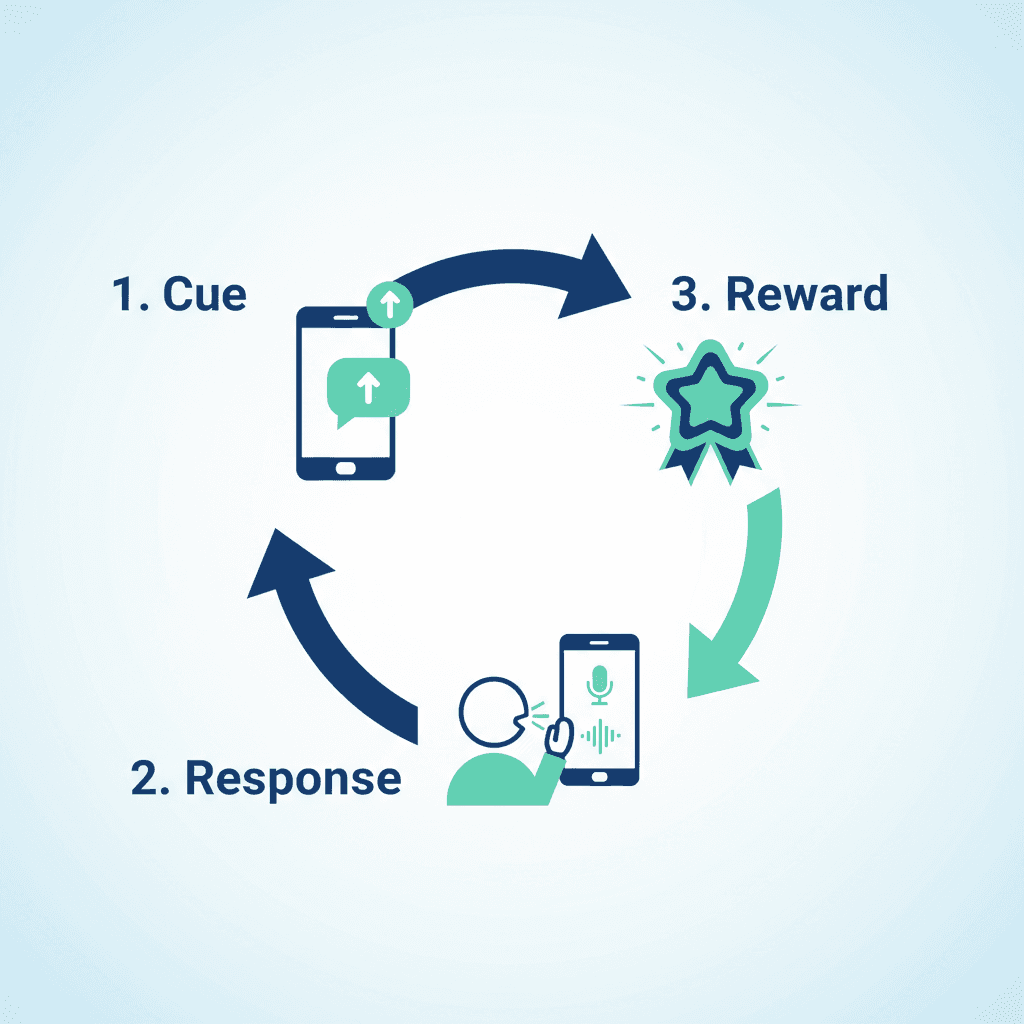
The secret to building a habit that doesn’t feel like a chore lies in neuroscience. The process is called the “habit loop,” a simple three-step framework: Cue, Response, and Reward. This is the behavioral engine that runs in the background of your life, powering everything from brushing your teeth to checking your phone. By consciously designing this loop for language learning, you can make your daily speaking practice automatic, something you simply do rather than something you have to force yourself to do.
Here’s how it works: The Cue is the trigger that tells your brain to initiate the behavior. The Response is the actual behavior itself—your speaking practice. The Reward is the positive reinforcement that tells your brain, “Hey, that was good. Let’s do it again.” This framework is being successfully adapted for AI-assisted learning to build study routines that finally stick. When you create a reliable loop, you bypass the need for constant motivation and build a system for language habit formation that works on autopilot.
Recent research in 2026 shows that using AI tools can have a positive effect on enhancing foreign language enjoyment and reducing speaking anxiety.
This is especially powerful for speaking, where a little bit goes a long way. Studies from Lingoda and ISSEN (2026) confirm that short daily sessions of just 10-15 minutes are more effective for building skills than longer, infrequent cramming sessions. Modern AI tutors are perfectly suited to facilitate this, holding realistic conversations and providing the instant feedback that makes the 'Response' and 'Reward' stages so effective.
Step 1: Design Your 'Cue' (The Unmistakable Trigger)
The first step in building an automatic habit is to create a clear, unmistakable trigger. The most effective way to do this is through a technique called “habit stacking.” Instead of trying to find new time in your day, you link your new speaking habit to an existing, rock-solid routine you already perform without thinking. Behavioral research confirms this is far more effective than scheduling a standalone activity. Your existing habit becomes the cue for your new one.
The formula is simple: After/Before [CURRENT HABIT], I will [NEW HABIT]. The key is to be specific. Don’t just say, “I’ll practice in the morning.” Instead, try:
- •“After my first sip of coffee in the morning, I will open my speaking app and practice for five minutes.”
- •“During my commute, right after I sit down on the train, I will complete one AI role-play scenario.”
- •“Before I close my laptop for the day, I will spend five minutes describing my workday in my target language.”
- •“After I brush my teeth at night, I will do a 5-minute speaking exercise instead of scrolling social media.”
Choose a trigger that fits your lifestyle, whether you're in a bustling city in India or a quiet suburb in Australia. A 2025 efficiency study by Preply found that learners with this kind of consistent daily trigger achieved far stronger results. Since it takes over 60 days to form an automatic habit, a reliable cue is the foundation that ensures you show up every day until your practice becomes second nature.
Step 2: Start with a 5-Minute 'Response' (Make It Easy)
Here’s where most people go wrong: they aim too high. They commit to an hour of practice, miss one day, feel defeated, and quit. The solution is to start “stupidly small.” Your initial goal isn’t fluency; it’s consistency. Make your daily speaking practice so easy that you can’t say no. We’re talking about just five minutes. This approach, often called a 'micro-habit', focuses on making the behavior stick first, before you worry about intensity.
As Dr. Judit Kormos, a leading expert in language learning, advises, consistency always beats intensity. A learner practicing for 15 minutes daily will surpass someone who studies for an hour only once a week. The goal is to design a habit that can survive your worst days—when you're tired, stressed, or unmotivated. A five-minute routine is achievable even on those days, and completing it keeps your streak alive. You’ll often find that once you start, you’re happy to continue for longer, but the initial commitment remains incredibly small and manageable.
To overcome the fear of speaking, your first 5-minute responses should be low-pressure. Don't try to debate politics. Instead, start by simply describing your surroundings, talking about your day, or narrating what you're doing. This simple act of producing the language aloud, without pressure, builds the foundational confidence you need to tackle more complex interactions later.
Step 3: Engineer Your 'Reward' (Feel Successful Immediately)
For a habit to stick, your brain needs to get a hit of satisfaction immediately after you perform the action. This is the reward. Neuroscience research reveals that rewards amplify dopamine-driven signals in the brain, strengthening the connection between the cue and the response. It’s what makes your brain crave doing it again. The more immediate and satisfying the reward, the faster the habit forms.
In language learning, one of the most powerful intrinsic rewards is simply the feeling of being understood. However, when practicing alone, you need to engineer this feeling. This is where modern tools can be a game-changer. An AI-powered tutor from a platform like SpeaksyAI provides an instant, judgment-free reward by offering real-time pronunciation feedback and tracking your progress. You get that immediate hit of 'I did it right!' which reinforces the habit without the anxiety of human judgment. Many platforms also use gamified elements like points and streaks, which are a dominant trend for increasing motivation.
You can also create your own rewards. The key is to celebrate the small win of showing up. Here are a few ideas:
- •Use a habit tracker: Put an 'X' on a calendar for every day you complete your 5-minute practice. The visual proof of your streak is a powerful motivator.
- •Level up your content: After a week of consistent practice, reward yourself by watching a short, fun video in your target language.
- •Share your progress: Post about your 7-day streak online or tell a friend. Public accountability and encouragement can be a huge boost.
- •Pair it with something you enjoy: Immediately after your practice, allow yourself a few minutes of a favorite podcast or a piece of chocolate. Your brain will link the speaking practice with that pleasant reward.
How to Scale Your Habit: From 5 Minutes to Confident Conversations
Once your 5-minute daily speaking habit is established (give it a few weeks!), it’s time to gradually increase the difficulty. This is how you turn a simple daily routine into a powerful engine for fluency. Because forming a robust habit takes over 60 days on average, a structured progression plan is essential to maintain momentum and avoid getting stuck. Here is a sample 4-week plan to take you from simple monologues to more dynamic conversations.
- 1.Week 1: The 5-Minute Monologue. Stick with your tiny habit. Use your five minutes to talk to yourself. Describe your room, narrate your coffee-making process, or talk about your plans for the day. The goal is simply to produce spoken language without pressure.
- 2.Week 2: Simple AI Role-Plays. Increase your time to 10 minutes. Now, use an AI partner to engage in simple, predictable scenarios. Practice ordering food at a restaurant, asking for directions, or introducing yourself. These familiar topics help you use core vocabulary in a structured way.
- 3.Week 3: Complex Scenarios. Aim for 10-15 minutes. Move on to more complex situations that require you to explain a problem, share an opinion, or ask follow-up questions. This is where the quality of your AI partner matters; you need a tool that can move beyond 'templated responses' and engage in a more natural back-and-forth.
- 4.Week 4: The 15-Minute Open Conversation. It's time to take off the training wheels. Try to hold a 15-minute open-ended conversation with your AI tutor about your hobbies, a recent movie you watched, or your job. The goal isn’t perfection, but sustained communication.
This gradual scaling system ensures that you are always challenging yourself just enough to make progress without feeling overwhelmed. Remember, research shows that this kind of consistent, focused daily practice—even just 20 minutes—can lead to measurable progress in as little as 4-6 weeks.
Overcoming Common Roadblocks and Staying Consistent
Even with the best system, you will face roadblocks. You’ll have days where you lack motivation, and you might even miss a day of practice. This is normal. The goal is not perfection, but persistence. To stay on track, adopt author James Clear’s powerful rule: never miss twice.
Missing one day is an accident. Missing two days is the start of a new, undesirable habit. Getting back on track with the next session is the key to maintaining your progress.
If you miss a day, don’t beat yourself up. Just make sure you show up the next day, even if it’s only for one minute. Remember, it takes over 60 days on average to make a new behavior automatic, so patience is non-negotiable. On days when your motivation is low and the 'intimidation factor' feels high, a judgment-free AI partner is your best friend. It allows you to maintain your habit and speak confidently without the fear of making mistakes in front of a person.
Maintaining a consistent speaking habit is critical because production skills (speaking, writing) often lag far behind recognition skills (reading, listening). This gap is where most learners get frustrated and quit. By following the habit loop and committing to a small, daily practice, you are directly targeting the most difficult—and most rewarding—part of your language learning journey.
Frequently Asked Questions
Frequently Asked Questions
Ready to Build Your Daily Speaking Habit?
Get judgment-free speaking practice 24/7 and turn consistency into confidence with our AI language tutor.
Join the Waitlist