Handle Speaking Mistakes in a New Language: A 3-Step System
Making mistakes is part of learning, but what do you do in the moment? This guide provides an actionable system for handling errors gracefully and turning them into valuable data for faster progress.
Why 'It’s Okay to Make Mistakes' Isn't Actionable Advice
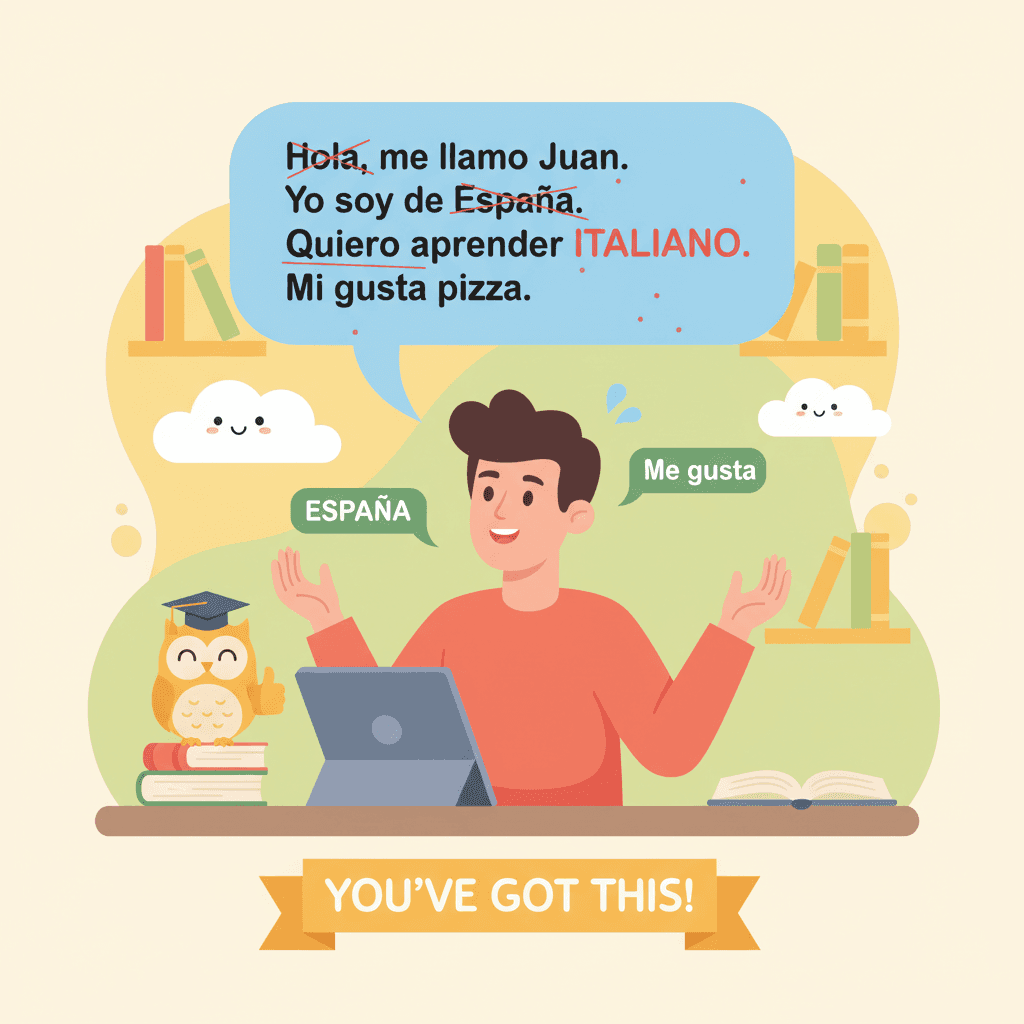
You've heard it a thousand times: “It’s okay to make mistakes!” While the sentiment is comforting, it’s not advice. It’s permission, but it doesn't tell you what to do next. For anyone serious about learning a new language, the real question isn't if you can make mistakes, but how to handle mistakes when speaking a new language in a way that actually helps you improve. What do you do in that split second of panic when you realize you've used the wrong word, fumbled a conjugation, or your sentence just came out as complete nonsense? Without a plan, that moment can lead to embarrassment and a retreat into silence.
This retreat is a classic symptom of the 'Perfectionist Trap,' a common blocker identified by researchers in 2025 where learners waste precious time waiting until they are 'perfectly ready' to speak. The irony is that the brain learns most effectively through the very process of making and correcting errors. A 2026 report from ScienceDaily even debunked the long-held myth that learners should focus on avoiding mistakes, arguing that prioritizing clear communication is far more effective for making progress. The goal isn't to be flawless; it's to be understood.
However, simply making mistakes without a system for feedback isn't the answer either. Experts warn this can lead to the 'fossilization' of incorrect patterns, where your errors become permanent habits that are difficult to unlearn. You need a middle ground: a system that allows you to maintain conversational flow while turning those inevitable slip-ups into powerful learning opportunities. It's about moving from feeling emotional about mistakes to treating them as logical data points for your improvement.
The 3-Step Mistake Handling System: Triage, Correct, Reflect
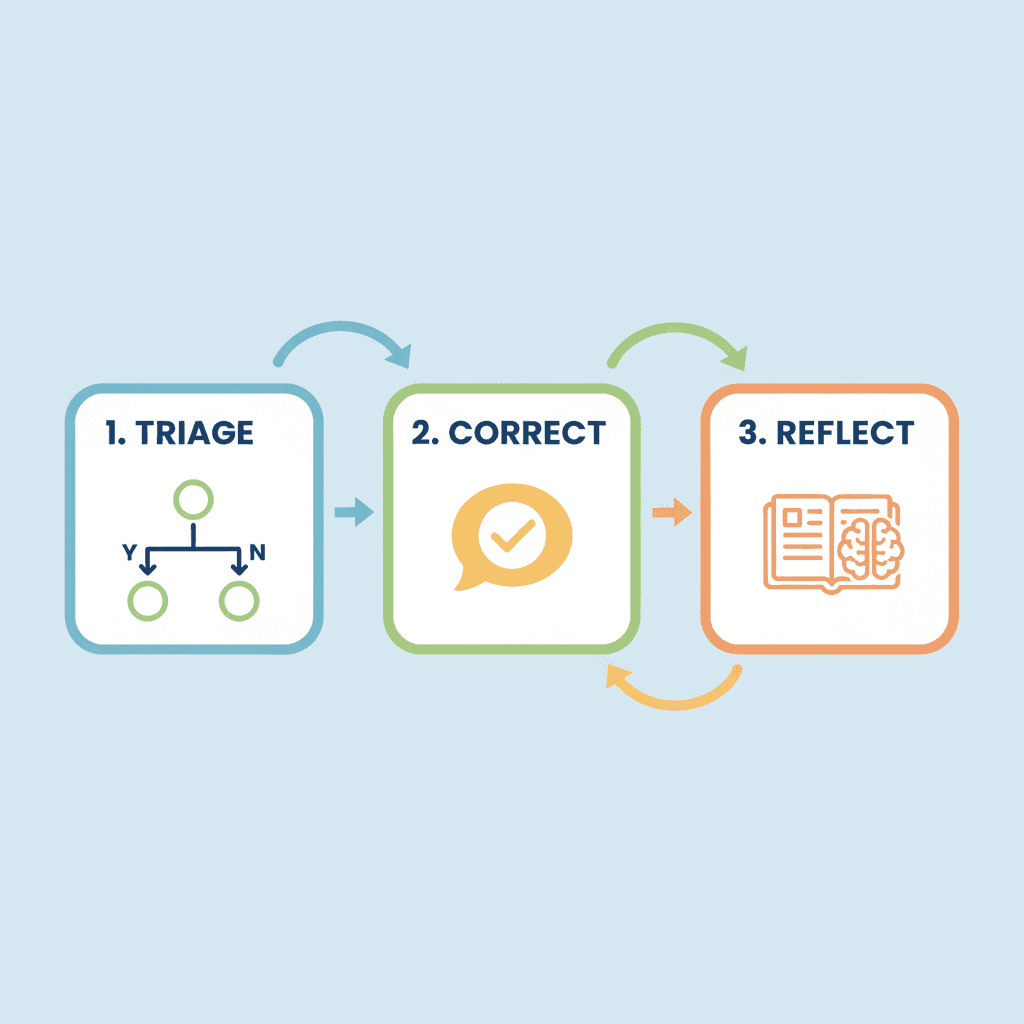
Instead of freezing up, what if you had a simple, repeatable process for every mistake you make? That's the goal of the 3-Step Mistake Handling System. It's a framework designed to turn a moment of panic into a structured learning opportunity. Research from 2025 confirms that mistakes are crucial for achieving fluency, but only when they're followed by effective cognitive processes of error correction. This system provides that process.
- 1.Triage: In the heat of the conversation, you'll make a quick decision: Is this mistake breaking communication, or can I move past it? This step is all about maintaining your momentum.
- 2.Correct: If a correction is needed, you'll learn how to do it gracefully without derailing the entire conversation. This builds confidence and shows your conversation partner you're actively engaged.
- 3.Reflect: After the conversation, you'll analyze the mistake. This is where the real learning happens, as you turn a fleeting error into a concrete data point for future practice.
This system acknowledges a key insight from a 2025 study on corrective feedback: we need to distinguish between 'errors' (a true gap in your knowledge) and 'mistakes' (a temporary slip in performance). This triage-like approach allows you to handle them differently, ensuring you don't get bogged down by minor slips while still addressing major gaps in your understanding. It puts you in control of your own feedback loop, which is essential for building lasting confidence.
Step 1: In-the-Moment Triage — What to Do Right Away
You're mid-sentence, and you feel it—that sinking feeling you've just said something wrong. Your first instinct might be to stop, apologize, and get flustered. The Triage step is about overriding that instinct with a logical decision. Your only goal here is to decide whether to stop or keep going.
- •Did the mistake break communication? For example, did you ask for 'soap' (jabón) instead of 'ham' (jamón) in a Spanish deli? If your partner looks confused, the mistake is likely communication-breaking. Decision: Proceed to Step 2 (Correct).
- •Was the mistake minor? For example, did you use the wrong gender for a noun or a slightly off-tense verb, but the meaning was still clear? If your partner understood you and the conversation is flowing, the mistake is minor. Decision: Ignore it and keep going!
This approach is backed by a 2026 report emphasizing that communication flow is more important than perfection. Prioritizing momentum over constant self-correction helps you avoid the 'Perfectionist Trap' and build conversational fluency. While you don't want major errors to become 'fossilized' habits, interrupting yourself for every minor gender agreement or preposition will kill your confidence and the natural rhythm of the conversation. For minor slips, the best move is to let it go and focus on getting your message across.
Step 2: Graceful Self-Correction (with Phrases You Can Use)
Okay, so you've made a communication-breaking mistake. Your triage assessment tells you a correction is necessary to get the conversation back on track. This isn't a moment for a lengthy grammar lesson. It's about making a quick, graceful fix and moving on. The key is having a few phrases for self-correction ready to go. Think of them as your conversational toolkit for recovering from mistakes in conversation.
Practicing these phrases beforehand is a great idea. As a 2026 report from Lingoda notes, learners are increasingly using AI conversation partners to practice these exact kinds of scenarios in a psychologically safe environment, free from the social pressure of a real-life conversation. Here are some 'magic phrases' you can use, adapted from a 2026 Study.com guide:
- •To correct a specific word: Sorry, I mean... / Oops, I meant to say...
- •To rephrase a confusing sentence: Let me rephrase that. / What I meant was...
- •To ask for the right word: Oh, what's the word for...?
Having these in your target language is even more powerful. Here are a few examples:
- •Spanish: Perdón, quise decir... (Sorry, I meant to say...)
- •French: Pardon, je voulais dire... (Sorry, I wanted to say...)
- •German: Entschuldigung, ich wollte sagen... (Excuse me, I wanted to say...)
- •Mandarin Chinese: 我的意思是... (Wǒ de yìsi shì... / What I mean is...)
By using a quick correction phrase, you're not just fixing an error; you're demonstrating to your conversation partner that you're actively working to communicate clearly. It turns a potential failure into a milestone of active learning, which is exactly how you should view every mistake.
Step 3: Reflect and Turn Mistakes into Data
This is the step that separates passive learners from proactive ones. The conversation is over, the pressure is off, and now you can convert those in-the-moment mistakes into lasting knowledge. The most effective way to do this is to treat your errors as 'data points' and analyze them systematically. This is where you can start a language learning mistake journal.
It doesn't have to be a fancy leather-bound book. A simple notes app on your phone or a dedicated document works perfectly. The goal, as highlighted in a 2025 guide, is to log your errors to identify personal patterns. This practice of 'error analysis' provides crucial information, helping you understand if your recurring issues are with pronunciation, verb tenses, or vocabulary. Here's a simple structure you can follow:
- 1.Log the Mistake: Write down the incorrect sentence or phrase you used.
- 2.Write the Correction: Note the correct version. If you're not sure, this is a great question for your tutor, a language exchange partner, or an AI tool.
- 3.Identify the Pattern: Add a tag or a short note. Was it a verb conjugation? A wrong preposition? Gender agreement? (e.g., '#ser-estar', '#gender', '#subjunctive').
- 4.Review Regularly: Once a week, spend 10 minutes reviewing your journal. You'll quickly see where your biggest challenges are, allowing you to focus your study time more effectively.
This reflective practice is a powerful antidote to the 'Perfectionist Trap.' By scheduling time to analyze your mistakes, you give yourself permission to not be perfect in the moment, because you know you have a system to catch and learn from them later. You are actively turning your speaking errors into a personalized curriculum for improvement.
Your Private 'Mistake Sandbox': Using an AI Tutor
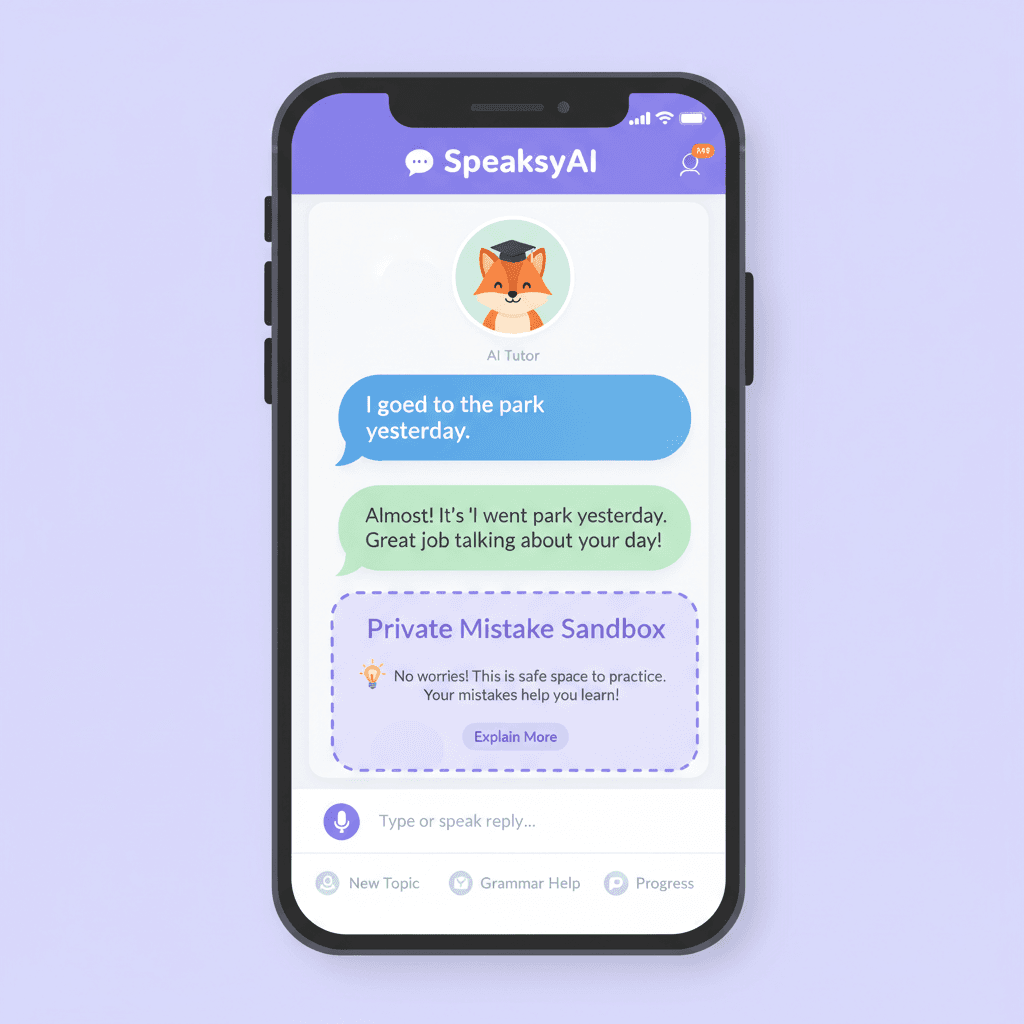
The entire Triage-Correct-Reflect system is incredibly powerful, but putting it into practice requires, well, practice. This can be intimidating with a human tutor or a language exchange partner where the stakes feel high. This is where AI for language speaking practice creates a revolutionary advantage. An AI tutor provides the perfect private 'mistake sandbox'—a zero-judgment, zero-anxiety environment where you can experiment, fail, and improve without fear.
Platforms like SpeaksyAI (at speaksyai.com) are designed for this exact purpose. Unlike a textbook, an AI tutor can provide instant, contextual feedback. It won't just tell you that you were wrong; it can explain why you were wrong, within the context of your own sentence. This is far more effective for learning than memorizing abstract grammar rules. You can run through dozens of conversational reps in the time it would take to have one or two real-world conversations, dramatically accelerating your ability to implement the 3-step system.
The real power comes from taking control of your learning. You can actively prompt an AI tutor to help you work on your specific weaknesses that you identified in your mistake journal. This turns the AI from a simple conversation partner into a personalized training tool.
By using an AI tutor as your dedicated practice partner, you build the muscle memory for handling mistakes correctly. When you do enter a real-world conversation in the US, UK, Australia, or anywhere else, the process will feel natural and automatic, freeing you up to focus on what really matters: connecting with another person.
Frequently Asked Questions
Frequently Asked Questions
Ready to Practice Without Fear?
Use the SpeaksyAI language tutor to make mistakes, get instant feedback, and build real speaking confidence in a private, judgment-free space.
Join the Waitlist