Get & Use Speaking Feedback: A 4-Step System for Confidence
Getting feedback on your speaking can be scary, but it's the key to fluency. This guide gives you a simple, repeatable system to request, process, and use feedback to speak confidently.
Why Most Speaking Feedback Fails (And How to Fix It)
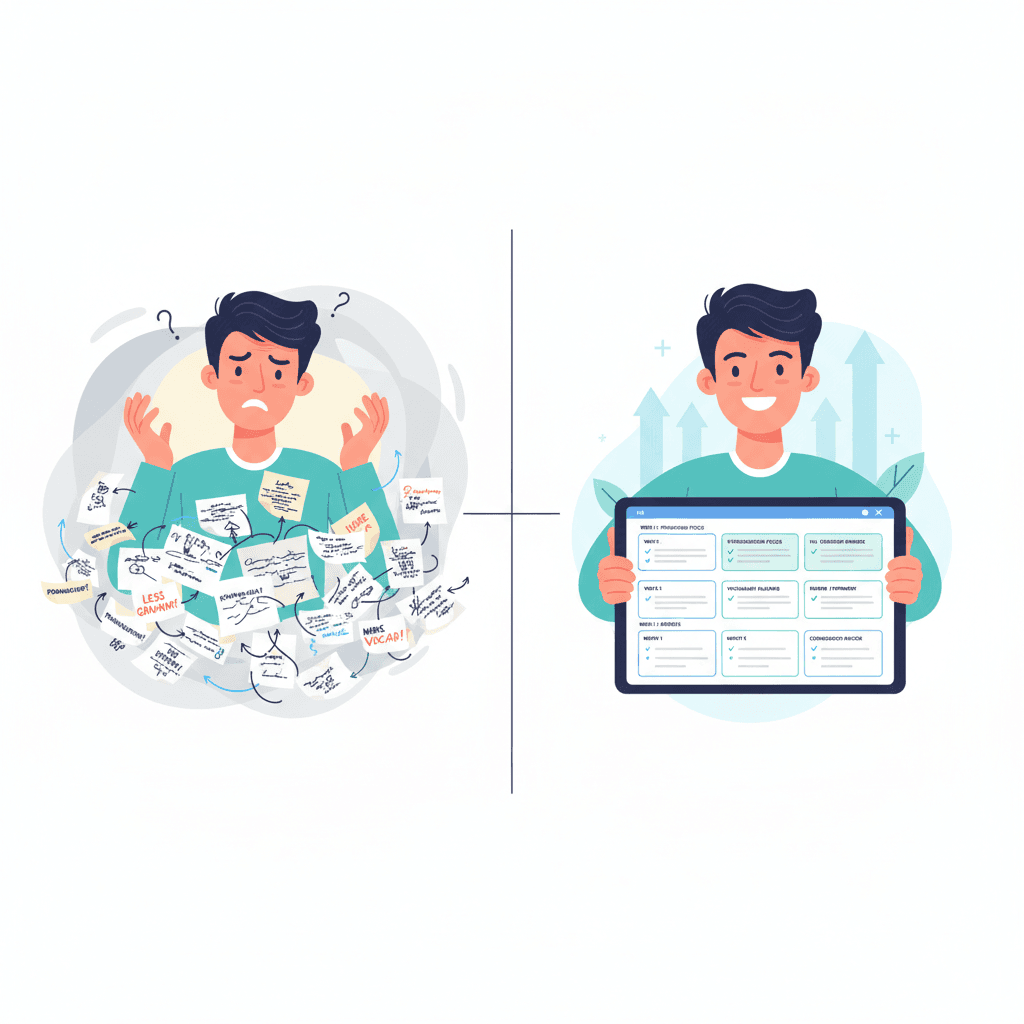
Let's be honest: asking for feedback can be terrifying. It feels like you’re inviting judgment. But what if the real problem isn’t the fear, but the feedback itself? Vague comments like “Good job!” or “You seemed nervous” feel nice (or not so nice), but they don’t help you improve. To make real progress, you need a new approach. This guide will show you how to get and use feedback on your speaking by turning it into a clear, manageable system, not a source of anxiety.
The difference between useless and useful feedback lies in its specificity. While generic praise is unhelpful, modern tools show what’s possible. A 2026 study, for example, found that AI could analyze verbal and non-verbal cues with 87.73% accuracy, offering highly specific insights into things like voice modulation and facial expressions. This is the level of detail that sparks real growth. When feedback is structured and actionable, it becomes your most powerful tool for improvement.
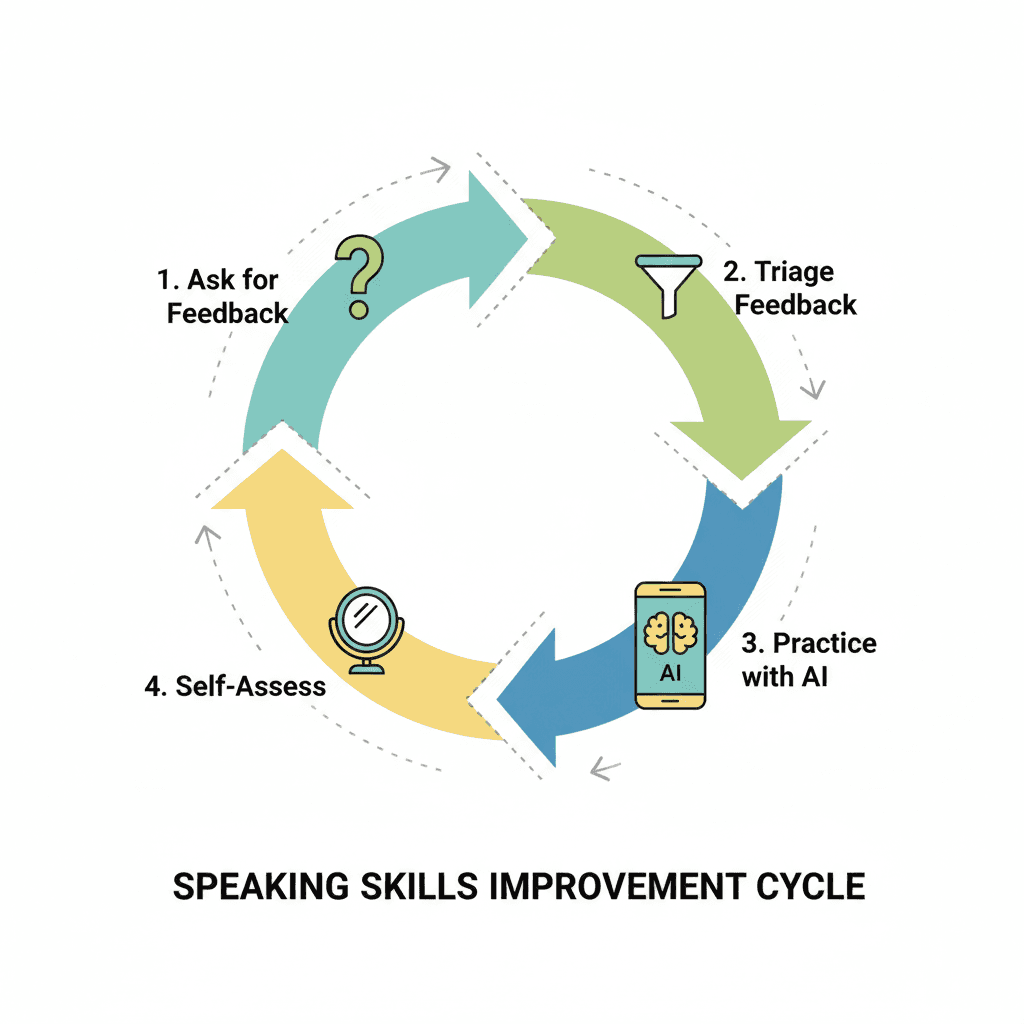
The solution is to stop hoping for good feedback and start designing a process to get it. By learning how to ask the right questions, triage the advice you receive, and use a targeted practice loop, you can transform feedback from a source of stress into a catalyst for confidence. Let's walk through the system step-by-step.
Step 1: How to Ask for Feedback You Can Actually Use

The first step in a better speaking feedback process is learning how to ask for feedback effectively. Instead of putting your conversation partner on the spot with a vague “What did you think?”, you need to guide them. By being specific about what you’re working on, you empower them to give you advice you can act on immediately.
Experts at Toastmasters International recommend speaking with your evaluator before your speech to request targeted feedback on specific areas. Then, according to BetterUp, you should ask your questions immediately after you speak, while the details are still fresh. Don’t be afraid to ask for what you need. Remember, the goal of constructive feedback is to help you improve. As the reviewer guidelines for the AISTATS 2026 conference state, the entire purpose of the review process is to help authors improve their work—the same is true for your speaking!
- •What was the key message you took away from my talk?
- •Was there any point where you felt confused or lost interest?
- •What is one thing I could change in my delivery to be more engaging?
- •How was my pacing? Did I speak too quickly or too slowly at any point?
Asking Your Tutor or Teacher
A one-on-one session with a tutor is the perfect setting for getting personalized, high-quality feedback. A 2025 systematic review found that students show greater achievement when feedback is tailored and action-oriented. Your tutor is there to help you refine your technique and build confidence. In fact, a 2026 study showed that over 68.1% of students agreed with their teachers' oral corrections, believing it directly helped their speaking competence. Don't be shy—they expect you to ask for help!
Try this script: “For our next session, could we focus specifically on my use of prepositions? I’d love for you to point out any errors I make in our conversation so I can start to notice them myself.”
This type of request encourages your tutor to use effective methods like elicitation (prompting you to find your own error) or metalinguistic feedback (giving grammatical clues), which a 2025 study found were highly effective at encouraging self-correction and student engagement.
Asking a Language Exchange Partner
Language exchange partners are fantastic for getting feedback on natural, conversational language. A 2025 study in the Journal of Language and Literature Studies found that a structured peer feedback process led to “statistically significant improvements” in both speaking fluency and accuracy. The key is to create a positive environment where your partner feels comfortable being honest.
Use this script to set the stage: “I'm really working on my pronunciation. For the next 10 minutes, would you mind correcting me if I say something that sounds unnatural? I promise I won't be offended—your honest thoughts are incredibly helpful!”
This approach is especially powerful for tackling “fossilized errors”—mistakes that have become habits. A native speaker can spot these instantly. By asking for targeted, personalized oral feedback, you can refine your pronunciation and speak more fluently, a finding supported by a May 2025 study in the Journal La Sociale.
Step 2: The Triage System for Processing Feedback
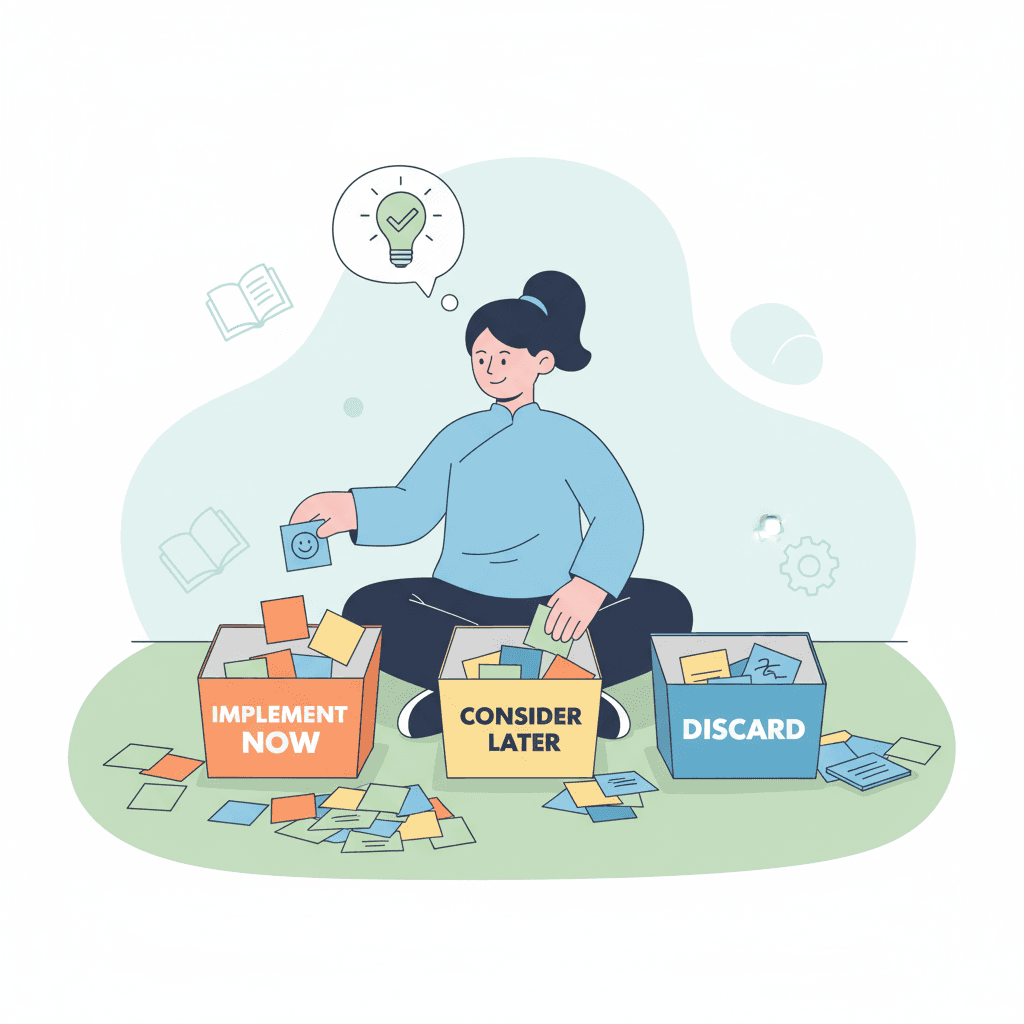
Once you get feedback, what do you do with it? It’s easy to feel overwhelmed. That's why the next step is to triage it. Just as telephone triage nurses use a system to prioritize patient needs, you can sort feedback to focus on what matters most. This systematic approach is proven; a 2025 study showed that Natural Language Processing could successfully transform raw patient feedback into actionable insights by categorizing it.
Sort every piece of feedback into a simple matrix:
- •Objective vs. Subjective: Is the feedback based on a factual rule (Objective, e.g., “You used the wrong verb tense”) or someone’s opinion (Subjective, e.g., “You sounded a bit hesitant”)?
- •Urgent vs. Non-Urgent: Does the feedback address a core, repeated error that is hurting your clarity (Urgent, e.g., incorrect pronunciation of common words) or is it a suggestion for future polishing (Non-Urgent, e.g., using more advanced vocabulary)?
Your top priority is feedback that is Objective and Urgent. These are the grammatical mistakes, fossilized errors, and mispronunciations that form the foundation of your speaking skills. Subjective feedback is still valuable, but it should be considered in context. If one person says you sounded hesitant but three others found you confident, you can probably deprioritize it.
Step 3: The Practice Loop: Using AI to Implement Changes
Now that you’ve identified your top priorities, it’s time for the practice loop. This is where you focus on implementing feedback speaking skills, and it’s where the synergy of human and artificial intelligence shines. After a human tutor or partner helps you spot a weakness, you can use an AI tool for high-frequency, targeted practice. A 2025 study found that integrating AI into language learning significantly improved fluency and accuracy by offering these kinds of personalized practice opportunities.
Imagine your tutor tells you that you consistently misuse the present perfect tense. Trying to fix this in your next high-stakes presentation is stressful. Instead, you can turn to an AI language tutor. Platforms like our AI language tutor, SpeaksyAI, are designed for this exact purpose. You can have dozens of low-stakes conversations where you focus specifically on using that one grammar point correctly, without any fear of judgment.
This method works because it provides a safe, effective environment for practice. A 2026 study highlighted that English Language Learners were highly satisfied with AI speech recognition feedback because it offered one-on-one guidance without the “fear of correction.” Furthermore, research from 2025 showed that students value the immediacy of AI tools, which allows them to identify and correct mistakes with pronunciation and fluency right away, creating a powerful loop of feedback and improvement.
Step 4: Self-Assessment – Becoming Your Own Best Critic
The final step of the system is learning to provide your own feedback through self-assessment speaking. This is a critical skill. A Gallup study found that only 14% of employees feel their performance reviews inspire them to improve—a huge gap that effective self-reflection can fill. By learning to analyze your own speaking, you become more self-aware and coachable, which is essential for continuous growth.
The most effective method for self-assessment is recording yourself. It might feel awkward at first, but it provides objective data on your performance. Use this simple three-step framework to analyze your recordings:
- 1.Listen for Flow: Play the audio without watching the video. Listen for filler words like “um,” “ah,” and “like.” Are your pauses intentional and confident, or do they sound like you’re searching for words?
- 2.Listen for Clarity: Is every word crisp and easy to understand? Pay close attention to your pronunciation, especially the endings of words. Are you mumbling or speaking too quickly?
- 3.Watch for Presence (for video): Now, watch the video with the sound off. How is your posture? Are you making eye contact (with the camera)? Do your gestures look natural and support your message, or are they distracting?
This process makes you an active participant in your own improvement. AI-powered tools can also help with this step, providing instant, objective feedback on your recordings by identifying filler words, measuring your pace, and flagging pronunciation errors in a low-stakes environment.
Beyond Words: Getting Feedback on Tone and Body Language
Effective communication goes far beyond the words you choose. Your tone of voice and body language play a massive role in how your message is received. A June 2026 study emphasized that mastering tone is critical for building trust and avoiding miscommunication. Yet, many speakers struggle to control their non-verbal cues due to nervousness, as a May 2026 study confirmed.
So, how do you get feedback on something so subtle? First, you can explicitly ask for it. Try asking a trusted peer, “Beyond my words, how did my delivery come across? Did I sound confident and approachable?” Second, self-recording is your best friend. Research from 2025 shows that interactive video training leads to significantly higher knowledge retention of body language cues, and reviewing your own video is a powerful form of that.
As technology advances, getting this feedback is becoming even easier. A February 2025 study explored real-time feedback displays that can analyze non-verbal cues like smiling, posture, and gaze during online meetings. Whether you're in the US, UK, Australia, or Canada, being mindful of these cues can dramatically improve your professional interactions.
FAQ: Your Speaking Feedback Questions Answered
Frequently Asked Questions
Ready to Turn Feedback into Fluency?
SpeaksyAI is your personal AI language tutor for low-stakes practice. Implement feedback and build confidence, one conversation at a time.
Join the Waitlist