Get Instant Pronunciation Feedback (No Tutor Needed)
Want to speak more clearly but don't have a tutor? You can get accurate pronunciation feedback right from your phone. Here's how to build a simple, effective routine.
You want to speak your new language more clearly, but getting useful feedback feels impossible. So, how can you get pronunciation feedback without a tutor? The great news is that you can get instant, detailed feedback by using an AI pronunciation feedback tool. These modern tools act like a personal language coach, analyzing your speech in detail and showing you exactly how to improve, all without the cost or scheduling pressure of a human tutor.
This guide will walk you through a complete system for improving your pronunciation on your own. We’ll cover how to find your specific weak spots, use AI to get phoneme-level corrections, and practice in a way that builds lasting confidence. Let's get you speaking more clearly, starting today.
Why Getting Good Pronunciation Feedback Is So Hard
If you've ever felt stuck with your pronunciation, you're not alone. It’s one of the biggest hurdles in language learning. You practice, you listen, but you still can't tell if you're saying it right. This is a common challenge, as most learners are simply unable to hear their own pronunciation errors, making external feedback essential.
Finding the right feedback is the tricky part. Tutors can be expensive and difficult to schedule, especially if you just need a quick check-in. Your language exchange partners or friends are often too polite to correct every mistake, fearing they might discourage you. In fact, poor pronunciation can be a bigger barrier to being understood than grammar mistakes, directly impacting how well someone can follow what you're saying.
Even when we do get feedback, it's not always helpful. A July 2025 research paper from the Duolingo English Test noted that many traditional scoring methods are based on outdated ideas of sounding 'native-like' instead of focusing on what truly matters: intelligibility. The goal isn't to erase your accent; it's to be understood clearly. Fortunately, new technology offers a solution. As a 2025 academic paper, Human–AI Feedback Loop for Pronunciation Training, detailed, AI-powered mobile apps can create a 'judgment-free' feedback loop, letting you practice privately and get the specific corrections you need.
The Modern Alternative: Your Personal AI Pronunciation Coach
Imagine having an expert on call 24/7, ready to listen to you speak and give instant, precise advice. That’s the promise of a modern AI pronunciation coach. This technology goes far beyond simply recording your voice. It acts as an on-demand 'AI language tutor' that analyzes your speech to improve your overall pronunciation clarity.
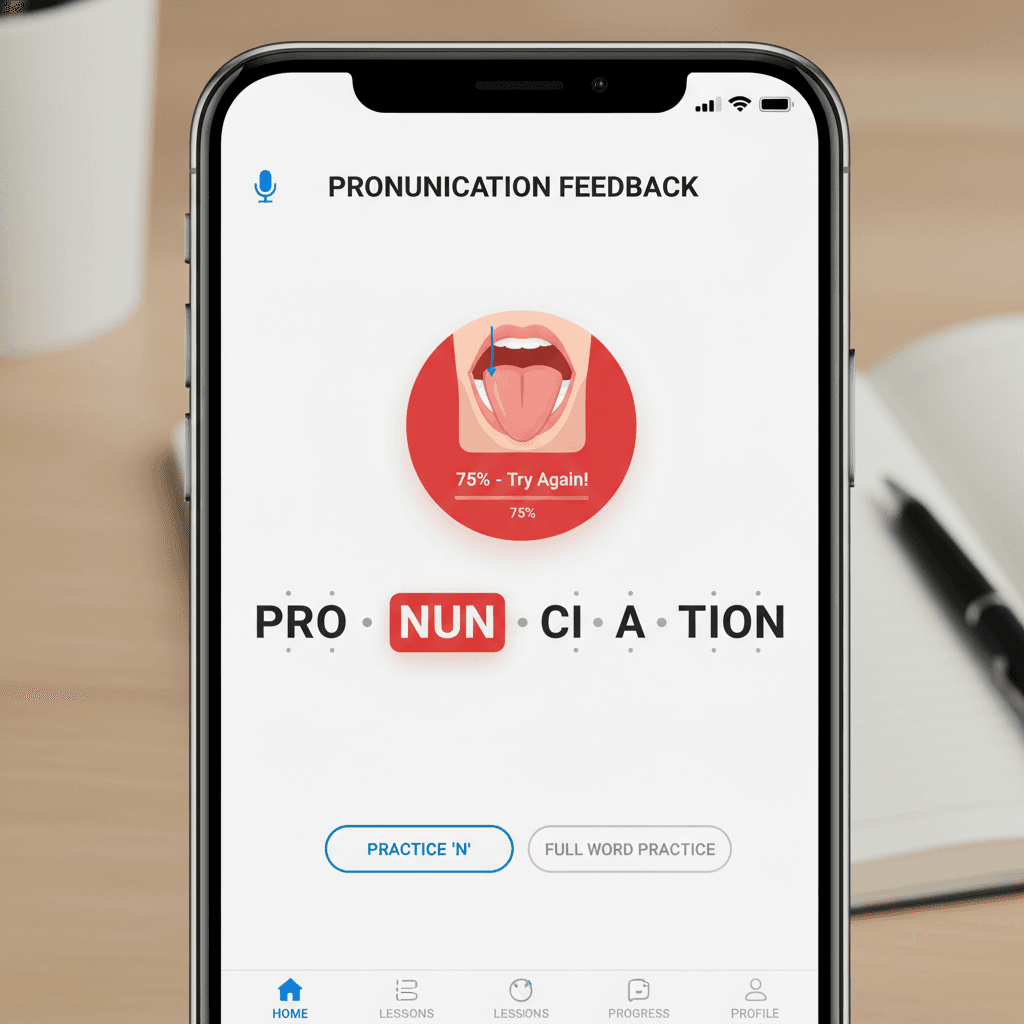
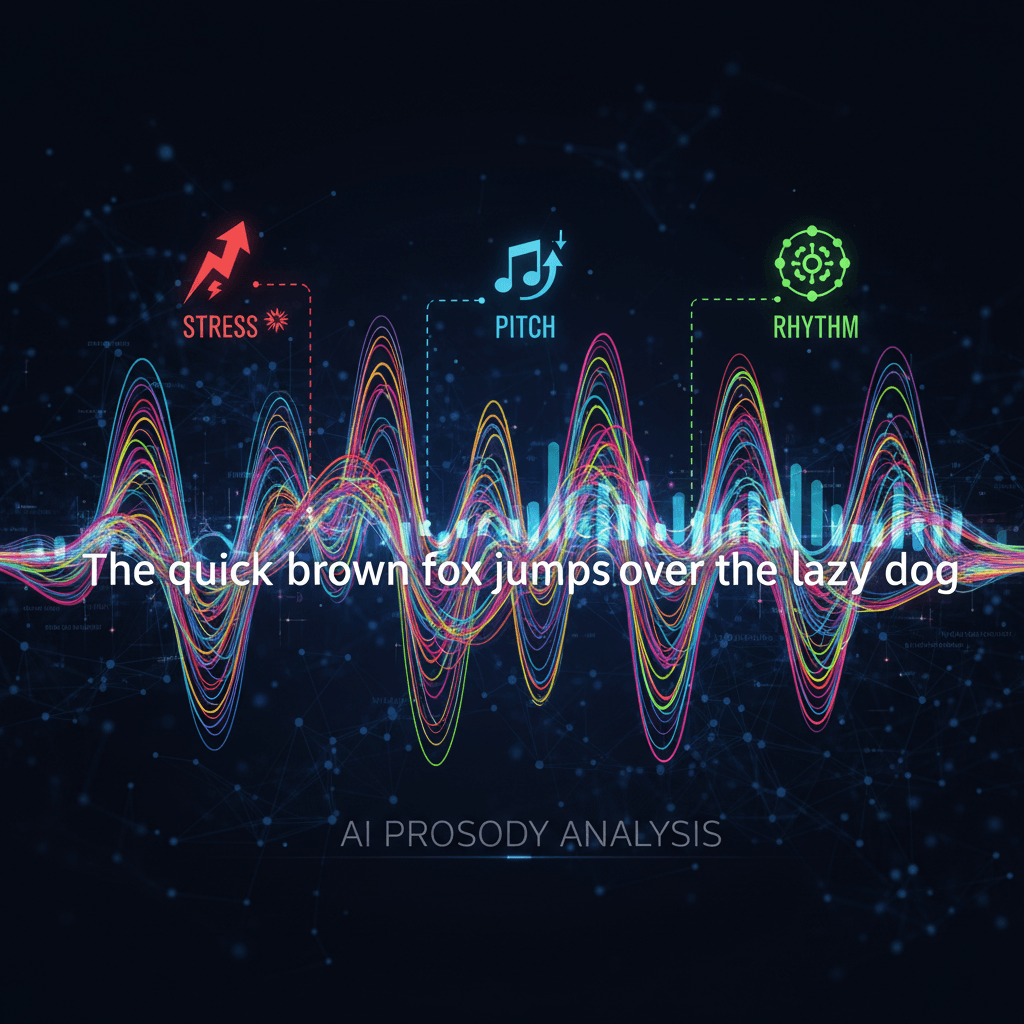
How does it work? According to a 2026 industry report on AI pronunciation coaching tools, these systems analyze a wide range of speech elements, including accent, stress, rhythm, and intonation, to provide detailed feedback. The technology has become incredibly sophisticated. A groundbreaking 2025 academic paper, Human–AI Feedback Loop for Pronunciation Training: A Mobile Application with Phoneme-Level Error Highlighting, described an AI app that provides interactive, phoneme-level error highlighting. Instead of just giving you a score, it shows you exactly which sounds in a word you mismatched, so you know precisely what to fix.
This shift towards granular feedback is part of a larger trend. The focus is no longer on accent reduction, but on improving 'pronunciation clarity'—the key factors like stress patterns and pacing that directly impact how well a listener in the US, UK, or Australia understands you. Some of the best AI language learning tools of 2026 even enhance this feedback with visual aids, like color-coded analysis of your tongue placement or sound motion graphics that show you how to form sounds correctly.
A 3-Step System for Daily Pronunciation Practice
Knowing the tools are out there is one thing; knowing how to use them effectively is another. To make real progress, you need a system. We call it the Pronunciation Feedback System, a simple, repeatable loop you can use daily to self-correct your pronunciation and build confidence. It’s designed to create what researchers in a 2025 MDPI paper call an 'interactive learner-system loop' that enables autonomous practice.
This system isn't just theory—it's backed by results. A 2026 systematic review of 22 studies published on ResearchGate confirmed that using AI-based pronunciation tools leads to measurable improvements in accuracy, confidence, and engagement. The system breaks down into three clear steps:
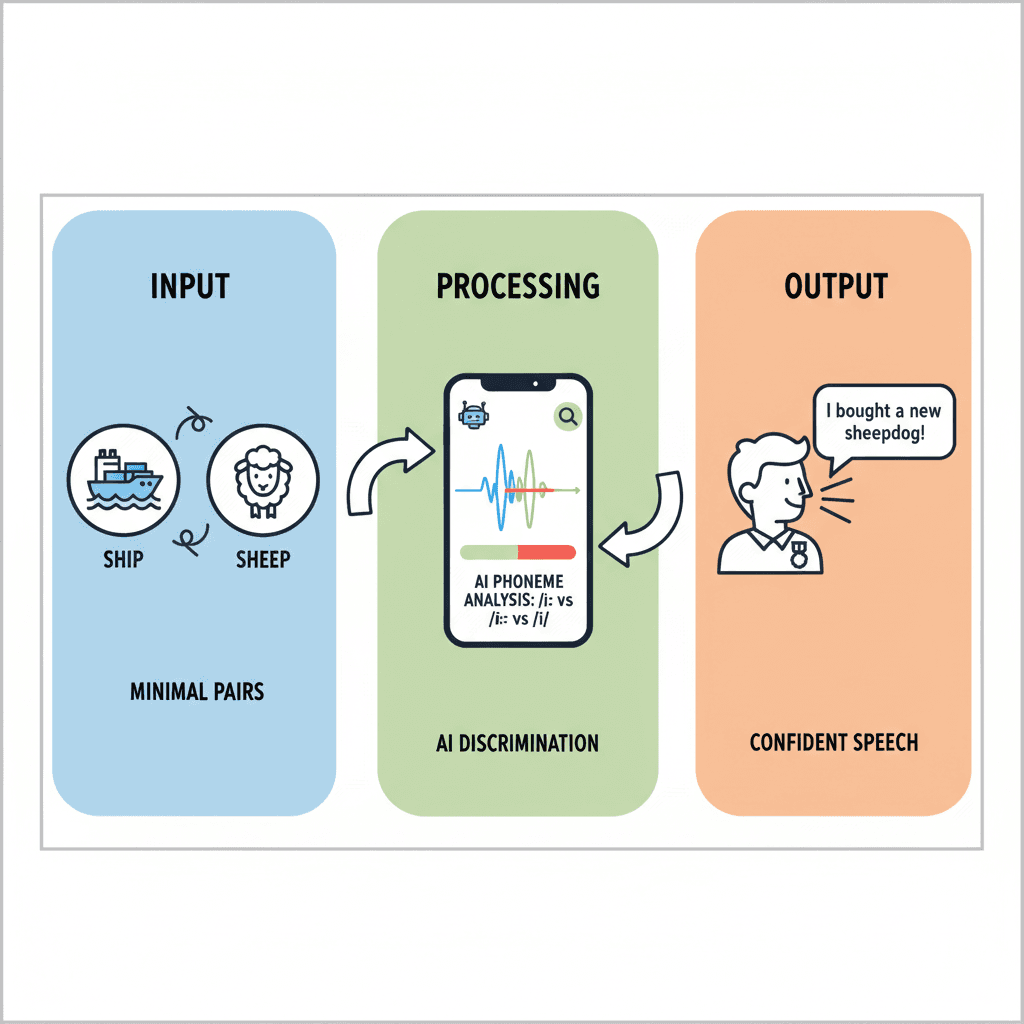
- 1.Isolate the Sound: Pinpoint the specific sound you struggle with using targeted exercises like minimal pairs.
- 2.Get AI Feedback: Record yourself and use an AI pronunciation feedback tool to get detailed, phoneme-level diagnostics.
- 3.Integrate into Sentences: Practice the corrected sound in the context of real sentences with an AI conversation partner.
By following this 'Isolate, Feedback, Integrate' loop, you turn passive listening into active, targeted practice. Let's break down each step.
Step 1: Isolate the Sound with Minimal Pairs
The first step is to figure out exactly where you're going wrong. Often, the problem lies in distinguishing between two very similar sounds. This is where minimal pairs come in. A minimal pair is two words that are identical except for one sound, like ship and sheep, or beach and—a famously tricky one for learners—bitch. Practicing these pairs helps tune your ear to the subtle differences you might be missing.
A 2025 guide from the MED-EL Professionals Blog even introduced 'The Minimal Pairs Test' as a formal method for pinpointing weaknesses in speech discrimination. It’s a powerful technique, and a qualitative study on the topic confirmed that students have highly positive perceptions of using it to improve their pronunciation. You can start by using free online tools like Forvo to hear a word spoken by native speakers from various regions, or YouGlish to find it in context within YouTube videos. Listen carefully to the target sound over and over. As research from 2024 shows, this kind of focused listening and production can help you improve even without a live teacher.
Step 2: Get AI Feedback at the Phoneme Level
Once you've identified a sound you want to work on, it's time to get feedback. This is where a powerful AI pronunciation feedback tool becomes your best friend. Use a tool like SpeaksyAI's real-time pronunciation feedback or another advanced app like ELSA Speak to record yourself saying the minimal pair words.
The key here is to look beyond a simple '85% correct' score. You want granular, phoneme-level feedback. As detailed in the 2025 paper Human–AI Feedback Loop for Pronunciation Training, the most advanced apps use a neural network to highlight specific phoneme mismatches. This means the feedback might show you that when you tried to say 'ship' (with the /ɪ/ sound), your vowel was actually closer to the /iː/ sound in 'sheep'. This is the kind of actionable data that leads to real improvement.
This technology, sometimes using a metric called 'Goodness of Pronunciation' (GOP), allows the AI to function like a speech therapist, pinpointing the exact source of the error. This is a major trend in the language learning industry, moving away from vague scores and toward interpretable, localized feedback that empowers you to check your pronunciation online and self-correct with precision.
Step 3: Integrate the Sound into a Real Sentence
Mastering a sound in isolation is a great first step, but the real goal is to use it correctly in conversation. The final step of our system is to take your corrected sound and integrate it into a full sentence. This is where practice meets reality. The goal is to make the correct pronunciation automatic, so you don't have to think about it when you're speaking.
An AI conversation partner is perfect for this. After practicing 'ship' and 'sheep', you could start a conversation with the AI and try to use sentences like, "I saw a large ship leave the harbor" or "The sheep are in the field." A 2025 study, "From Chalk to Chatbots," found that using AI chatbots for this kind of practice is incredibly effective for boosting motivation and self-reflection. An August 2025 study of 77 university students further confirmed that practicing with speech-to-text technology significantly improved phoneme-level pronunciation because the immediate feedback helped learners self-correct in real time.
Tools with Automatic Speech Recognition (ASR) help learners improve accuracy quickly by providing immediate feedback for sentence practice, which fosters learner autonomy and helps reduce speaking anxiety.
This practice is reliable. A January 2025 study in PMC demonstrated that advanced algorithmic systems for pronunciation can achieve a teaching evaluation accuracy of 99.3%, so you can be confident in the corrections you receive. For more ideas, check out our guide on how to use AI for conversation practice.
Going Beyond Sounds: Feedback on Rhythm, Stress, and Intonation
Clear pronunciation isn't just about individual sounds (segmentals). It's also about the 'music' of the language—the rhythm, stress, and intonation, collectively known as suprasegmentals. This is what makes a language flow naturally, and getting it right is crucial for pronunciation clarity. Think about the difference between 'pro-JECT' (the verb) and 'PRO-ject' (the noun). The sounds are the same, but the stress pattern changes the meaning entirely.
For a long time, analyzing suprasegmentals was a known challenge for automated systems, as noted in a March 2026 systematic literature review. However, modern AI can now tackle this. A 2025 study found that AI systems use natural language processing to assess word stress and pitch patterns, providing learners with real-time visual feedback. This aligns perfectly with the industry-wide trend of focusing on overall clarity—achieved through correct stress and pacing—over chasing a 'native' accent.
Cutting-edge research from July 2026 even details methods for AI to score rhythm by analyzing speech signal timing and intonation by combining pitch and intensity features. Some gamified pronunciation practice apps are already embedding this, creating challenge loops where you must vocally 'beat' a bot by recreating sentences with the correct intonation and rhythm. This allows you to improve the naturalness of your speech, helping listeners in places like Canada or India understand you with less effort.
How to Handle AI Feedback (And Not Get Discouraged)
Receiving a stream of corrections, even from a machine, can feel a little daunting. The key is to treat the feedback as data, not judgment. You're a scientist experimenting with new sounds, and the AI is your lab equipment, providing neutral, objective measurements. Every correction is a valuable piece of information that gets you one step closer to your goal.
This approach is more than just a mindset trick; it's about building 'feedback literacy.' A 2026 study on the topic found that learners who learned to appreciate and act on AI suggestions gained far greater benefits. The goal of modern tools isn't to criticize, but to support. A July 2026 article from Queen Mary University of London advocates for AI that provides 'psychologically safe' and 'emotionally attuned' feedback.
Celebrate the small wins. If you improved your score on a difficult word from 60% to 70%, that’s progress! Focus on gradual improvement, not overnight perfection.
In fact, a major August 2026 meta-analysis confirmed that AI feedback has a significant positive effect on students' self-regulated learning, especially by boosting motivation. So, when you get a low score on a new word, don't get down. Instead, get curious. Look at the phoneme-level breakdown. Is it the vowel? The consonant? The stress? Use the data to refine your next attempt. Every try is a step forward.
Frequently Asked Questions
Frequently Asked Questions
Ready for Instant, Personalised Feedback?
SpeaksyAI is the AI language tutor that gives you detailed pronunciation feedback in a judgment-free space. Join the waitlist to start speaking confidently.
Join the Waitlist