Free AI Speaking Practice: The 3-Step System for Confidence
Feeling nervous to speak a new language? Discover how to use free AI speaking practice tools not just to talk, but to build real confidence with our simple 3-step system.
What if you could build real speaking confidence without the fear of making mistakes? For many language learners, the biggest hurdle isn’t grammar or vocabulary—it’s the anxiety of speaking out loud. The secret isn't just finding a patient language partner; it's leveraging the power of free AI speaking practice. These incredible tools provide a safe, judgment-free space where you can talk, stumble, and improve on your own terms, turning your smartphone into a personal fluency coach.
Why Free AI Is Your Secret Weapon for Speaking Confidence
Let's be honest: speaking a new language can be intimidating. The fear of saying the wrong thing or having someone wait impatiently for you to find your words is real. This psychological barrier is often the final boss of language learning. AI tutors completely remove this pressure. There's no judgment, no awkward silences, and no one to impress. It's just you and the technology, creating the perfect environment to take risks and find your voice.
This isn't just a feeling; it's backed by data. A 2024 survey from the language platform Elispeak found that building confidence is the single biggest motivator for learners starting with AI, cited by 26.7% of respondents. When you remove the fear, you unlock your potential to practice more freely and consistently. This is especially true for the 52.6% of new AI tutor users who self-rate their proficiency between the B1 and B2 levels—a stage where active practice is critical for breaking through the intermediate plateau.
Practicing in this safe space delivers tangible results. A 2024 user survey from SmallTalk2Me confirmed that learners feel significantly more confident practicing with an AI than with humans, which directly translates to faster progress. This confidence-first approach is the foundation for building fluency and making the leap to real-world conversations.
The 3-Step System for Effective Daily AI Speaking Practice
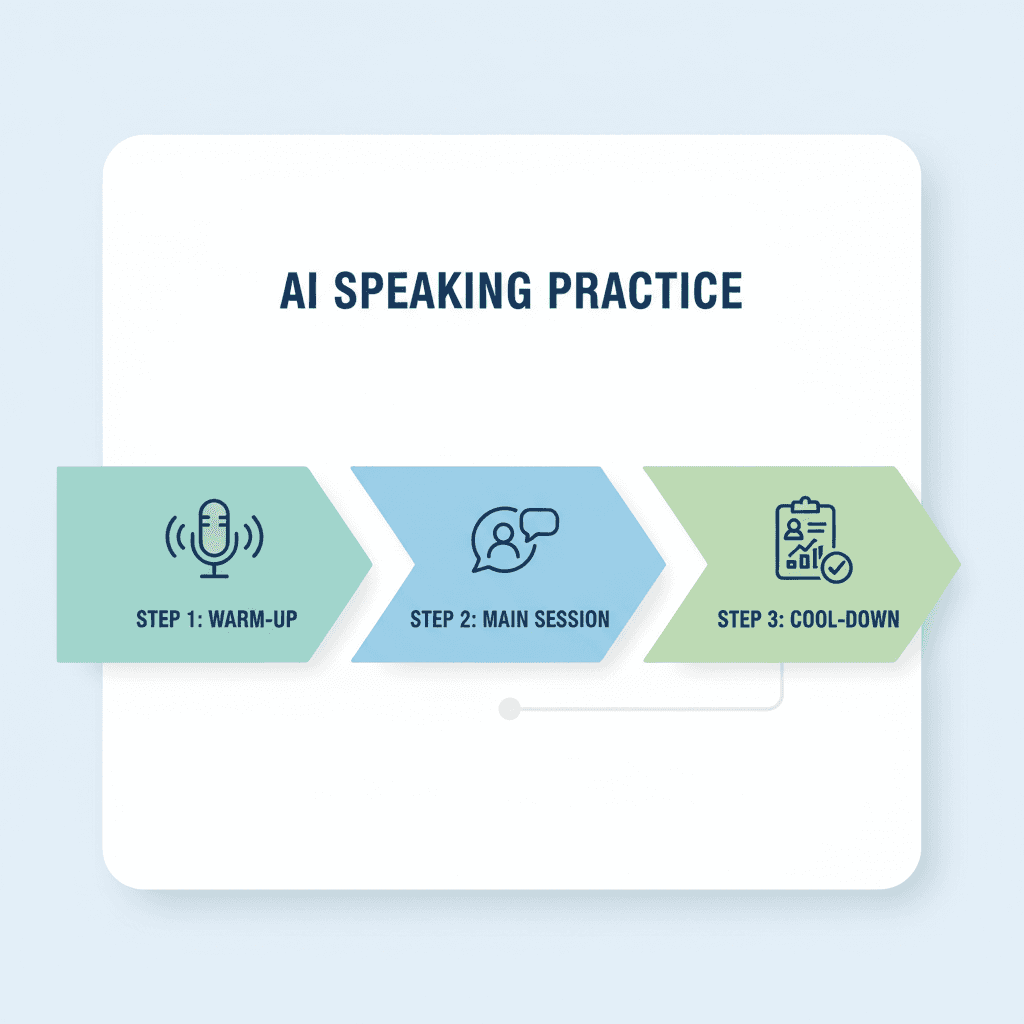
Consistency is everything in language learning. To turn random practice sessions into real progress, you need a plan. We’ve developed the 20-Minute Daily AI Speaking System—a simple, effective routine to build a powerful speaking habit. It’s designed to fit into your busy life and maximize your gains without causing burnout.
Why 20 minutes? Research from Elispeak's 2024 user report shows that 41.3% of new learners aim for this exact amount of speaking practice per day, making it a popular and achievable goal. Furthermore, a 2024 review from the International Symposium on Social Sciences and Engineering (ISSEN) noted that several short sessions are more effective than one long one for building conversational automaticity. This system breaks your practice into three manageable parts:
- •The Warm-Up (5 Minutes): Get your mouth and mind ready to speak.
- •The Main Session (10 Minutes): Engage in targeted, scenario-based practice.
- •The Cool-Down (5 Minutes): Review feedback and set a goal for tomorrow.
Step 1: The Warm-Up (5 Mins)
The goal of the first five minutes is simple: just start talking. Don't worry about perfection or complex sentences. This low-pressure warm-up helps you transition into a speaking mindset and overcomes the initial inertia. Think of it like stretching before a workout. You’re just getting the muscles moving.
Pick a simple, open-ended topic and talk about it for five minutes straight. The key is to keep speaking, even if you pause or make mistakes. Here are a few ideas to get you started:
- •Describe the room you are in right now in detail.
- •Talk about what you had for breakfast or lunch.
- •Summarize a movie or TV show you recently watched.
- •Explain your plans for the upcoming weekend.
- •Talk about your favorite hobby and why you enjoy it.
Many free AI tools are perfect for this, offering short, timed conversations that are ideal for a quick, low-stakes warm-up. You're building momentum and reinforcing the idea that speaking is an accessible, everyday activity.
Step 2: The Main Session: Scenario-Based Practice (10 Mins)
Now that you're warmed up, it's time for the main workout. For these ten minutes, you'll focus on scenario-based practice. Instead of just chatting aimlessly, you’ll engage in ai role-playing free of charge with your AI tutor. This method is incredibly powerful because it prepares you for specific, real-world situations you'll actually encounter, whether you're traveling, in a business meeting, or just going about your day in an English-speaking country like the US, UK, or Australia.
Give your AI a role and a context. For example, you could practice ordering a flat white in Melbourne, asking for directions to the Tower of London, or navigating a customer service call with a company in the US. A 2024 review of 24 studies found that practicing with AI chatbots leads to measurable gains in fluency and a significant reduction in speaking anxiety. You're not just practicing words; you're rehearsing for life.
- •Travel Scenarios: Booking a hotel, ordering at a restaurant, asking for directions.
- •Work Scenarios: A mini job interview, participating in a meeting, giving a short project update.
- •Social Scenarios: Making small talk at a party, telling a story to a friend, making plans.
Step 3: The Cool-Down: Reviewing Your Feedback (5 Mins)
Your practice session isn't over when you stop talking. The final five minutes are dedicated to the cool-down: reviewing your feedback. Many tools now offer some level of free AI pronunciation feedback, grammar corrections, or vocabulary suggestions. However, looking at a list of your mistakes can feel discouraging if you don't have the right mindset.
The goal here is not to fix everything at once. This is especially important for intermediate learners, who make up over half of new AI tutor users. Instead, scan the feedback and pick just one or two things to focus on for your next session. Maybe it’s the pronunciation of a specific vowel sound, or perhaps you consistently misuse a preposition. By isolating a single target, you turn feedback from criticism into an actionable game plan for improvement.
A Practical Walkthrough: Using ChatGPT Voice for Free Practice
One of the most accessible tools for AI conversation practice free of charge is the voice feature within the official ChatGPT app. While it’s a general assistant, not a dedicated language tutor, its open-ended nature is perfect for the warm-up and role-playing exercises in our 20-minute system. Getting started is simple.
- 1.Download the Official App: Make sure you have the official ChatGPT app from OpenAI on your smartphone.
- 2.Log In and Tap the Headphones: Open the app and tap the headphone icon in the bottom right corner to initiate a voice session.
- 3.Set the Scene with a Prompt: The first thing you say is crucial. Give the AI a clear role and context so it knows how to respond.
- 4.Start Talking: Engage in a conversation! The AI is designed to have a natural, back-and-forth dialogue.
Let's role-play. You are a friendly librarian in Canada, and I am a visitor asking for help finding a book. I want to practice my English. I will start the conversation.
The technology is impressive, using OpenAI's Whisper model to transcribe your speech and a powerful text-to-speech model to reply in a natural-sounding voice. This allows for near-real-time conversation that mimics human interaction. While the free tier has daily limits, it offers more than enough time to complete your 20-minute practice session.
Top 3 *Truly* Free AI Speaking Tools (and Their Limits)
While many apps claim to be free, they often operate on a 'freemium' model. Because processing real-time AI conversation is expensive, most free tiers come with limitations. The key is finding the tool whose free offering best matches your goals. Here's a look at a few popular options and what you can realistically expect.
1. Google Gemini: As a general AI assistant similar to ChatGPT, Gemini's main advantage is its unlimited, open-ended voice chat. It's an excellent choice for the 'Warm-Up' portion of your practice or for unscripted conversations. The Limit: It's not a language tutor. You won't get structured scenarios, curriculum, or detailed feedback on your pronunciation and grammar. You have to guide the conversation and ask for corrections manually.
2. Talkpal: This is a dedicated language learning app that offers a free tier. It provides scenario-based conversations and role-playing, making it a great option for the 'Main Session' of your practice. The Limit: The free plan typically caps daily practice time, often around 10-15 minutes. This is enough to get started but may feel restrictive as you build your habit, especially since many users aim for 20 minutes a day.
3. Elispeak: This app focuses on a 'permanently free' tier that offers a specific amount of practice each day without a trial period. It provides structured, scenario-based conversations with corrections, making it a well-rounded option for executing the full 20-minute system. The Limit: The daily time limit is the main constraint. To get unlimited practice time and access more advanced features like in-depth pronunciation analysis, you’ll need to subscribe.
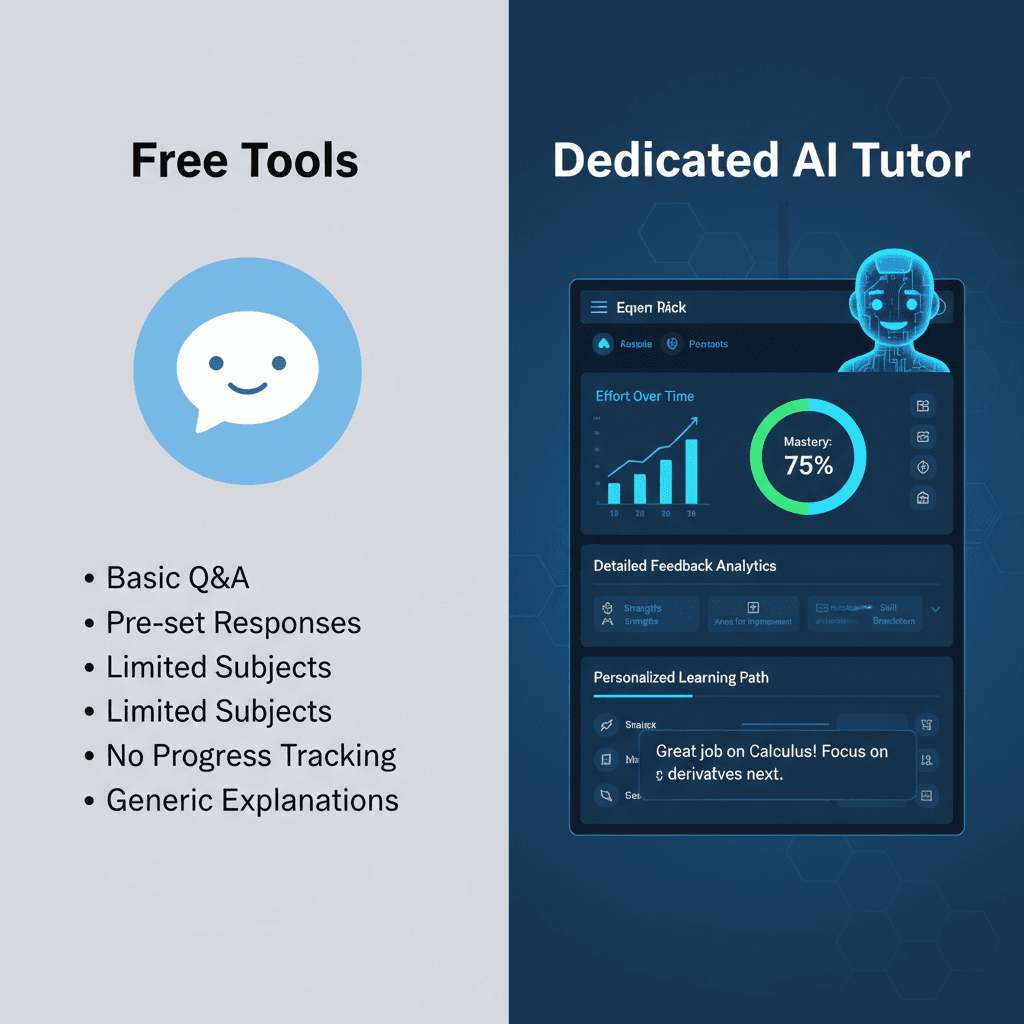
Beyond Free Tools: When to Upgrade to a Dedicated AI Tutor
Free tools are a fantastic gateway to building a speaking habit and gaining initial confidence. They prove the concept and help you get comfortable talking to an AI. But there will likely come a point when you hit a ceiling. You might find the daily time limits restrictive, the feedback too generic, or you may crave a more structured path to fluency.
This is the perfect time to consider upgrading to a premium, dedicated AI tutor. Learners often make this move when they reach the B1-B2 intermediate level and realize they need more sophisticated feedback to improve. When your main goal shifts from simply 'starting to speak' to 'speaking fluently and confidently,' the investment in a specialized tool becomes worthwhile. The global market for AI in education is growing rapidly, with a projected value of over $9.5 billion in 2024 according to VirtualSpeech, because learners are seeing real results from these advanced platforms.
This is often the point where learners are ready to invest in a dedicated tutor. Platforms like SpeaksyAI are designed to solve these exact problems by providing unlimited practice, adaptive learning paths, and detailed feedback on pronunciation, intonation, and grammar. The structured approach of a premium tutor like SpeaksyAI helps you move from casual practice to targeted, efficient improvement, saving you time and accelerating your journey to fluency. And with many top-rated services costing around $10-15 per month, it’s an affordable investment in one of life's most valuable skills.
Frequently Asked Questions (FAQ)
Frequently Asked Questions
Ready for the Next Level in Your Speaking Journey?
SpeaksyAI offers unlimited, personalized practice with an AI language tutor that never gets tired. Get the feedback you need to speak confidently.
Join the Waitlist