DET Speaking Practice: The AI System for a High Score
Struggling with the fast-paced Duolingo English Test speaking section? Discover the AI-powered system to practice effectively for new question types and get the score you need.
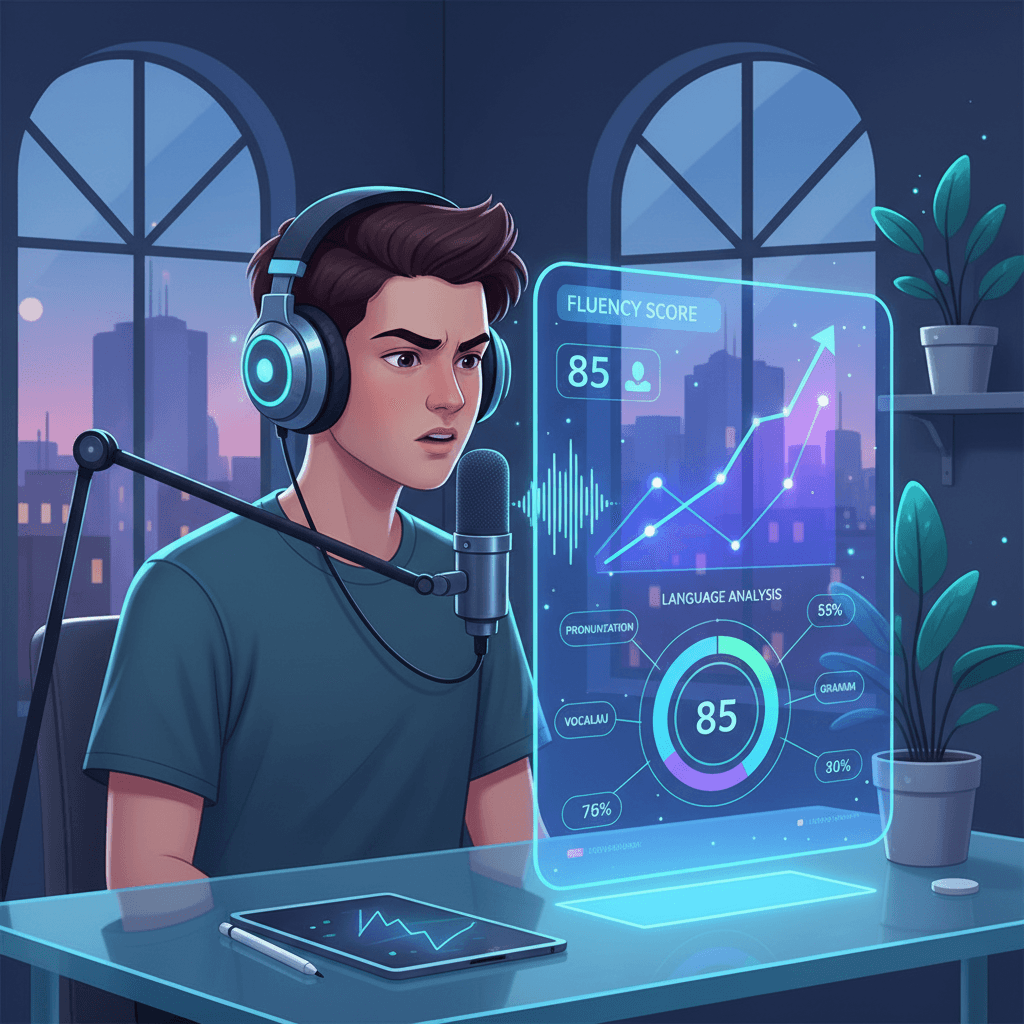
Feeling the pressure to ace the Duolingo English Test? You're not alone. With its unique, fast-paced, and AI-driven format, traditional study methods often fall short. If you want to truly excel, you need a modern approach to duolingo english test speaking practice that simulates the real exam and prepares you for its specific challenges. This guide will walk you through a proven system to not only practice effectively but also to speak with the confidence needed to achieve a top score.
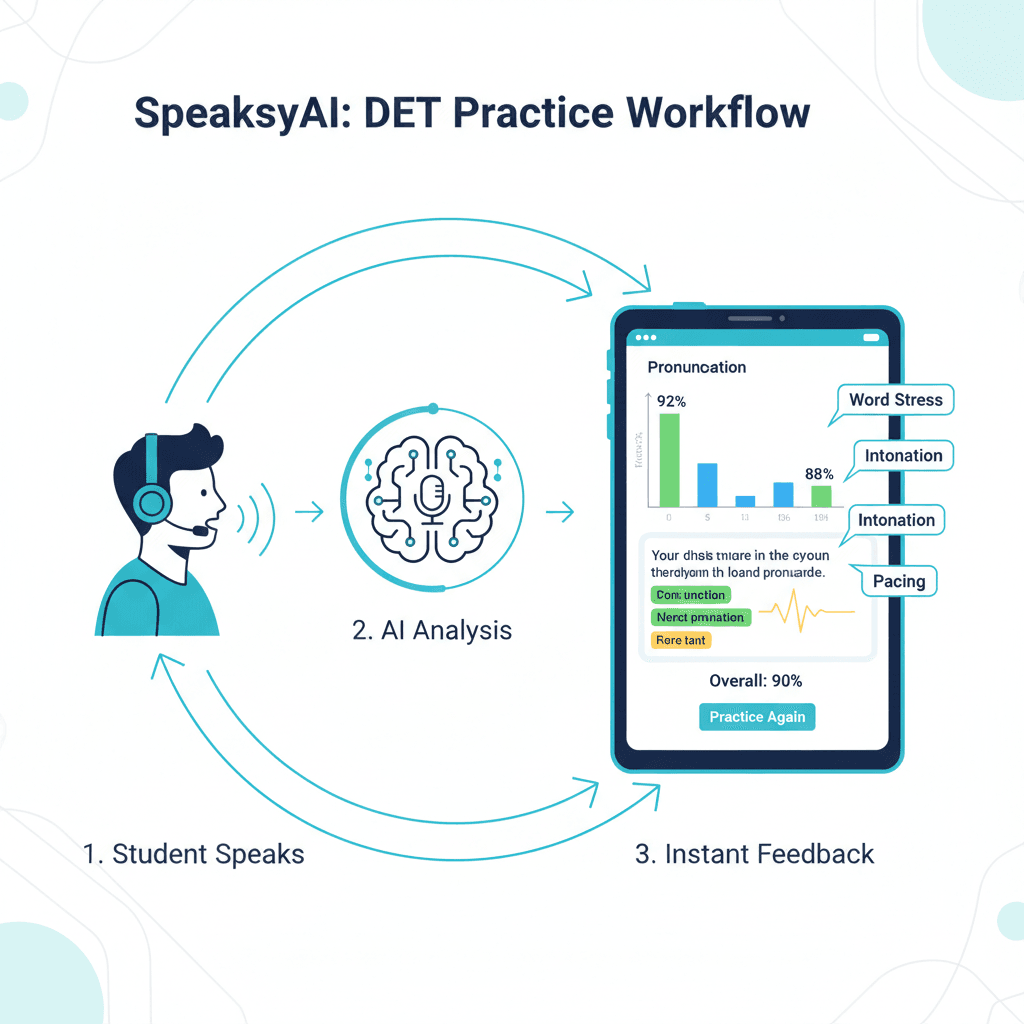
Why Old Practice Methods Don't Work for the AI-Powered DET
If you’re preparing for the Duolingo English Test (DET) with old textbooks or passive listening exercises, you might be setting yourself up for a surprise. The test has evolved significantly, especially with its 2026 update. As of July 1, 2025, a brand-new 'Interactive Speaking' section was introduced, fundamentally changing the speaking portion of the exam. This new format features a conversation with an animated AI character, requiring you to think and respond in real-time. According to the Duolingo English Test Speaking Questions & Practice guide (2026), practice materials from 2024 or earlier are now considered outdated because they simply cannot replicate this interactive experience.
The core challenge of the DET is its dynamic and adaptive nature. Unlike a static page in a book, the test's AI adjusts the difficulty based on your answers. The 'Interactive Speaking' section is a prime example; as noted by Det Study Blogs in 2025, the AI character's questions often build on your previous responses. This tests your ability to think on your feet, a skill that passive listening or memorizing pre-written answers can't develop. Rote memorization, a staple of traditional test prep, is particularly ineffective here, as the DET's AI is specifically designed to measure genuine, spontaneous language ability.
Another key difference is feedback. When you study with a textbook, you have no way of knowing how your speaking sounds, if your grammar is correct, or if your vocabulary is varied enough. You have to wait for a teacher or a study partner. In contrast, modern AI-powered practice platforms provide an immediate, data-driven evaluation of your speaking performance. This instant feedback loop allows you to spot mistakes, understand your weaknesses, and improve much more rapidly. Finally, preparing for the DET isn't just about language skills; it's about getting comfortable with the strict, computer-proctored environment. The test's AI and human reviewers monitor everything from background noise to your physical movements, a unique pressure that only simulated online practice can prepare you for.
The SpeaksyAI System for DET Speaking Practice
To conquer a modern test, you need a modern strategy. Forget scattered tips and outdated books; what you need is a clear, repeatable system. As the Duolingo English Test grows in popularity—with 1 in 5 international applicants to US universities using it in 2025 (SQ Magazine, 2026)—standing out requires a structured approach. That's why we developed the SpeaksyAI System, a three-part framework designed to build your skills methodically for every part of the speaking test.
- 1.Simulate the Test Environment: Get comfortable with the AI-driven format by practicing in a realistic setting.
- 2.Target Specific Question Types: Focus your efforts on the exact types of questions you'll face, from picture descriptions to the new interactive conversation.
- 3.Use AI Feedback for Rapid Improvement: Leverage instant, detailed feedback to pinpoint errors and systematically improve your fluency, pronunciation, and grammar.
The 2026 DET update made simulating the test environment more crucial than ever. With the 'Interactive Speaking' section, you're literally having a conversation with an AI. The best way to prepare for this is to practice with an AI language tutor that can replicate this back-and-forth conversational flow. Next, your practice must be targeted. The DET speaking section isn't one single task; it’s a series of different challenges. A great practice platform will have a large, dedicated question bank—some offer over 5,000 questions—allowing you to master each format. Finally, the system hinges on using feedback effectively. Leading AI-powered apps, a major trend for 2026, provide targeted feedback that shows you exactly where you went wrong and how to fix it, which is the fastest path to a higher score.
Mastering the NEW 'Interactive Speaking' Section (Post-2025)
The biggest change to the Duolingo English Test in recent years is the 'Interactive Speaking' section, which officially launched on July 1, 2025. This new format replaced the older 'Read Aloud' and 'Listen, Then Speak' tasks, shifting the exam’s focus toward more practical and realistic conversational abilities. Instead of just repeating a sentence, you now engage in a simulated conversation with an animated character who asks a series of 6 to 8 questions. This update reflects the test's goal to better assess how well you can actually use English in a spontaneous, interactive setting.
The Interactive Speaking section is structured as two separate conversational scenarios. In each scenario, you’ll see a prompt setting the scene, followed by a series of questions from the AI character. Your challenge is to provide relevant and coherent responses for up to 35 seconds for each question. Because the conversation is adaptive, preparing requires more than just memorizing answers. The best way to prepare for this AI-driven format is to practice with an AI tutor like the one on speaksyai.com, which can simulate the real-time, adaptive conversational flow you'll experience on test day. This aligns perfectly with 2025-2026 language learning trends that emphasize interactive AI-based practice.
Step-by-Step Guide: The 'Picture Description' Question
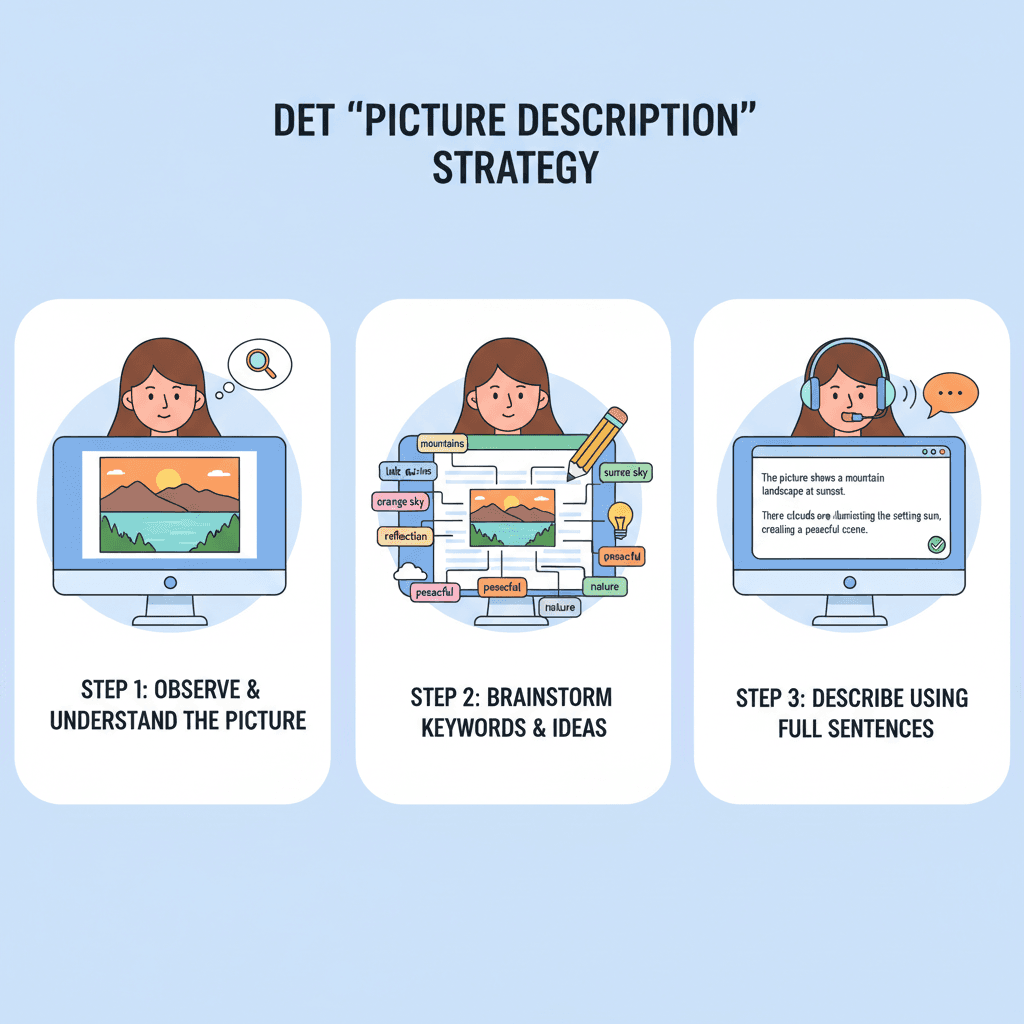
One of the classic DET tasks that remains crucial is 'Speak About the Photo,' also known as the Picture Description question. Your response here contributes directly to your 'Production' and 'Conversation' subscores, which evaluate everything from your grammar and vocabulary to fluency and coherence. While Duolingo removed the minimum speaking time for this question in 2025, you still need an efficient, structured approach to deliver a comprehensive answer that showcases your skills. Simply listing objects isn't enough; you need to demonstrate descriptive and speculative abilities.
To craft a high-scoring response every time, use this simple three-step framework:
- 1.Start with the Big Picture: Begin with one clear sentence that summarizes the entire image. What is the main subject or action? This gives your response immediate focus.
- 2.Describe the Key Details: Move from the general to the specific. Talk about the people, objects, and actions you see. Use prepositions to describe where things are (e.g., 'in the foreground,' 'on the left side,' 'behind the main subject').
- 3.Add Informed Speculation: This is where you can really shine. Go beyond what you see and talk about what might be happening. What is the mood? What might have happened before this moment, or what could happen next? Use modal verbs like 'might,' 'could,' or 'seems to be' to frame your speculation.
For example, if you see a picture of people laughing in a park, you could start with the big picture: 'This image shows a group of friends enjoying a sunny day in a park.' Then, describe the details: 'A young woman with a red jacket is laughing while looking at her phone, and two other people are sitting on a blanket next to a picnic basket.' Finally, add speculation: 'They seem to be having a wonderful time, perhaps celebrating a special occasion. They might be planning to play a game or just continue chatting for the rest of the afternoon.' This structured approach ensures your answer is detailed, well-organized, and hits all the key scoring criteria.
Crafting a High-Scoring 'Speaking Sample' (With Practice Prompts)
At the end of the test, you'll encounter the 'Speaking Sample.' While this 1-to-3-minute response is technically 'unscored' by the DET's AI, the video recording is sent directly to the universities and programs you apply to. Think of it as your virtual interview—it's your chance to make a personal impression and showcase your communication skills in a less structured format. Institutions review this sample to assess six key criteria: Content, Coherence, Grammar, Lexical Resources (vocabulary), Fluency, and Pronunciation.
To make a strong impression, structure your response with a clear beginning, middle, and end. Start by directly addressing the prompt, expand on your ideas with examples or personal experiences, and conclude with a brief summary. Below are three common types of prompts you can copy and use for your own DET speaking practice. Try answering them on a platform that offers timed practice, such as SpeaksyAI.
Practice Prompt 1 (Education):
Describe a subject you enjoyed studying in school. Explain why you found it interesting and how it has influenced your academic or career goals.Practice Prompt 2 (Personal Experience):
Talk about a time you had to adapt to a new situation. What was the situation, what challenges did you face, and what did you learn from the experience?Practice Prompt 3 (Opinion):
Some people believe that technology has made people less creative. Do you agree or disagree with this statement? Explain your reasoning with specific examples.Building Confidence and Overcoming Speaking Anxiety
Let's be honest: speaking in a test is nerve-wracking. The speaking section is often cited as the most variable part of the DET in terms of scoring, which only adds to the anxiety. In fact, nervousness is so common that entire courses are dedicated to helping test-takers manage uncertainty and speak with more confidence. But confidence isn't something you're born with; it's a skill you build through practice. The key is to find a way to practice that feels safe and encouraging.
This is where practicing with an AI tutor can be a game-changer. An AI provides a non-judgmental space to make mistakes without fear. A study published on ResearchGate found that using a language learning application not only improved students' pronunciation but also significantly boosted their confidence in speaking. When you can practice anytime, anywhere, and get instant feedback without feeling embarrassed, you start to see every mistake as a learning opportunity. This is a core idea behind the 2025-2026 trend of AI apps that simulate real-world conversations to build confidence.
- •Start with short, low-pressure sessions. Try speaking for just 30 seconds on a simple topic. Celebrate that small win!
- •Focus on one goal at a time. Instead of trying to fix everything at once, dedicate a practice session to improving your pace, using more varied vocabulary, or correcting a specific pronunciation error.
- •Record and listen to yourself. It might feel strange at first, but hearing yourself is one of the best ways to identify areas for improvement.
- •Use your AI tutor as a safe space. Answer a prompt, review the feedback, and try again. This iterative process is the foundation of building lasting confidence.
How to Use AI Feedback to Boost Your DET Speaking Score
Practicing is important, but practicing smart is what leads to a higher score. The goal of using an AI tutor is to leverage its feedback to directly address the DET's scoring criteria. As of 2025, DET score reports provide separate scores for individual skills like speaking, which makes it easier than ever to see your weaknesses and use targeted feedback to improve them. Remember, the DET's AI scoring models were trained on thousands of human-rated samples and agree with human experts about 85% of the time—so the feedback you get from a well-designed AI tutor is highly relevant.
Studies from 2025 by researchers like Pusparini et al. demonstrated that AI applications significantly improved students' speaking skills, including pronunciation and fluency, by providing instant feedback.
When your AI tutor gives you feedback, don't just glance at it. Map it directly to the DET's scoring rubric. For example:
- •Pronunciation & Pace Feedback: This directly impacts your 'Acoustic Features' score. Use the feedback to work on specific sounds and maintain a clear, natural rhythm.
- •Grammar Corrections: This helps improve your 'Grammatical Accuracy' and 'Grammatical Complexity' scores. Pay attention to repeated errors in verb tense or sentence structure.
- •Vocabulary Suggestions: This targets your 'Lexical Sophistication' and 'Lexical Diversity' scores. Try to incorporate new, more advanced words into your next response.
By systematically using AI feedback to refine your performance on these key metrics, you are actively training for the test's scoring algorithm. This data-driven approach turns practice from a guessing game into a targeted strategy for improvement, helping you increase your improve duolingo speaking score.
Frequently Asked Questions about DET Speaking Practice
Frequently Asked Questions
Ready to Ace Your DET Speaking Section?
Get unlimited AI-powered practice and instant pronunciation feedback to speak confidently on test day.
Join the Waitlist