Beyond 'How Are You?': A Guide to Deep Conversations
Tired of small talk? Moving to deeper topics in a new language can feel intimidating. This guide provides a practical system to help you speak confidently about what truly matters.

Why Deep Conversations Feel Like the Final Boss of Language Learning
Learning how to have deep conversations in a foreign language isn't about passing a final, high-stakes fluency test—it's about mastering a system. It’s a skill you build step-by-step, not a sign of 'arrival'. This system involves creating a psychological safe space, learning to gently pivot from small talk, and practicing with the right tools. Once you have it, you can move beyond surface-level chats and start building real, meaningful connections with people, no matter what language you're speaking.
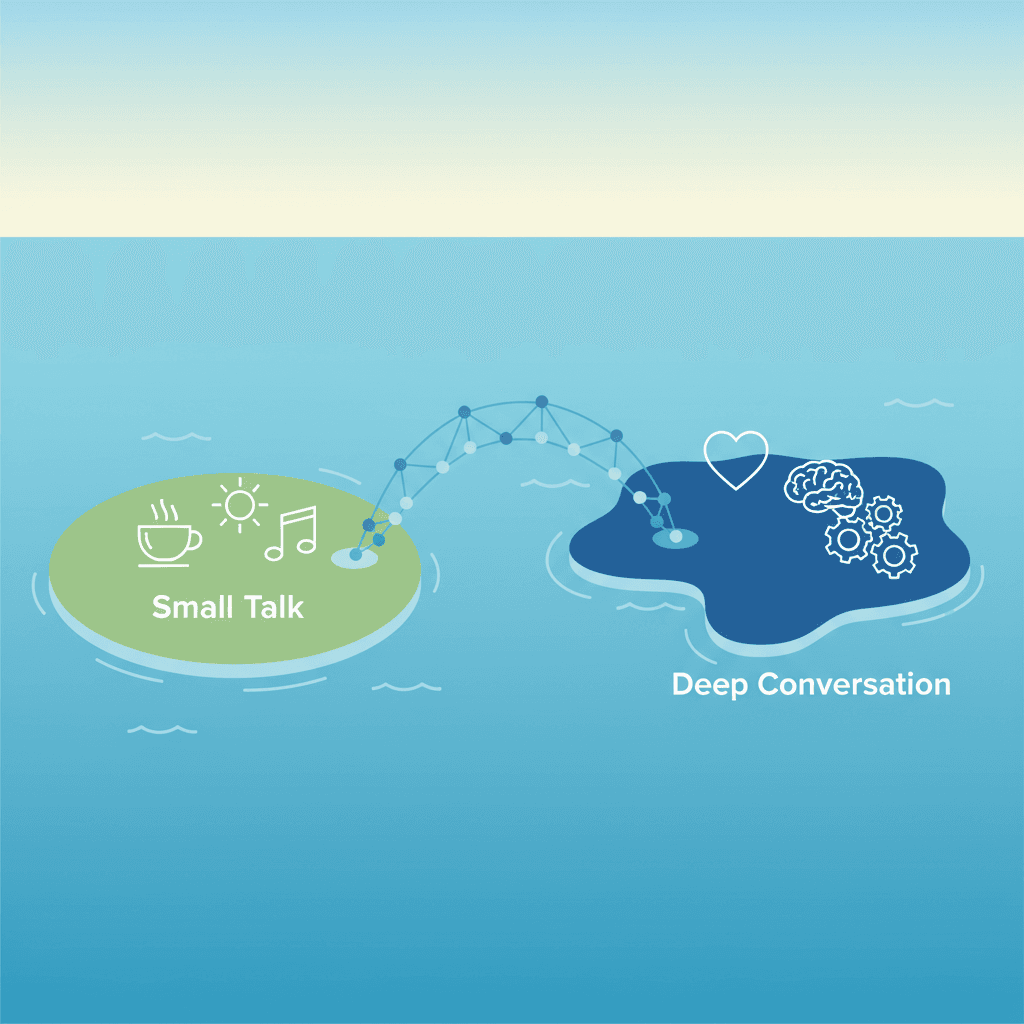
Let's be honest: trying to discuss complex topics in a second language can feel overwhelming. You’re juggling grammar, searching for vocabulary, and trying to understand cultural nuances all at once. This cognitive load is immense. Add a fear of being judged for every mistake, and it’s no wonder many learners stick to safe topics like the weather. This exact challenge is a major reason why many people quit. In fact, learners report that the period after the first 100 hours is critical; it’s when the initial excitement fades and the real challenges of fatigue and self-doubt set in, causing many to give up.
But here's an encouraging twist: speaking a new language can sometimes make vulnerable conversations easier. A fascinating study on bilingualism and emotion found that a second language can create a sense of emotional distance. For some, this distance makes it less intimidating to discuss difficult feelings than it would be in their native tongue. It's a reminder that this journey is as much about psychology as it is about vocabulary. This guide will give you The Deep Conversation System to navigate these challenges, overcome the fear, and speak confidently about the things that truly matter to you.
Step 1: Build Your Psychological 'Safe Space'
Before you even think about what to say, you need to work on how you feel. The biggest barrier to deep conversations isn't your vocabulary; it's the fear of being vulnerable. You worry about making a grammatical mistake, saying the wrong thing, or being misunderstood. The first step is to give yourself permission to be imperfect. Reframe your goal from 'perfect fluency' to 'genuine connection.' When you make a mistake, it's not a failure—it's a moment of shared humanity that can actually bring you closer to the other person.
This idea is supported by the concept of 'psychological safety,' which research in Mind Brain Education defines as an environment where you feel safe enough to take interpersonal risks—like trying to express a complex thought in a new language—without fear of embarrassment. This is why many learners quit within the first 100 hours; they are psychologically unprepared for the self-doubt that comes with hitting a plateau. By consciously building your own safe space, you're creating the resilience needed to push past that common roadblock.
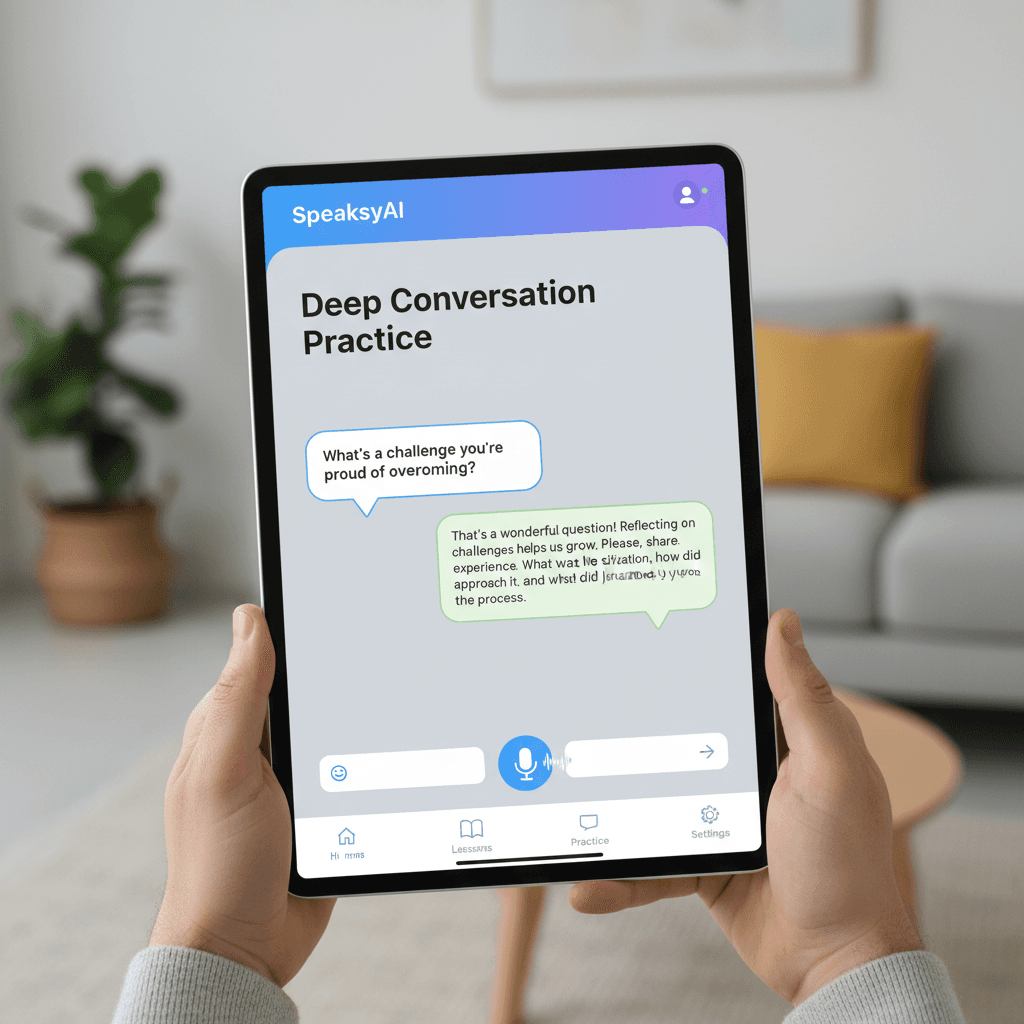
Your first safe space for practice doesn't even have to involve another person. As research highlights, digital learning environments are ideal for overcoming speaking anxiety. Using an AI tutor, for example, allows you to practice articulating your thoughts on deep subjects without any fear of judgment. It’s your private rehearsal room where you can build confidence before taking the stage in a real conversation.
Step 2: How to Gently Pivot from Small Talk to Deep Talk
Meaningful conversations rarely start out deep. Small talk is the essential bridge you build to establish rapport and trust. Think of it as the 'gateway to deeper discussions,' as one guide on conversation skills puts it. The key is to not get stuck there. To move beyond pleasantries, you can use a simple, three-part framework: Listen, Validate, Escalate.
- 1.Listen: Pay close attention to what the other person is saying. A common pitfall for language learners is focusing so much on what they'll say next that they miss openings. A recent study found that learners often overuse 'speaker strategies' and underuse 'listener strategies.' Practice active listening to catch a word or topic that has emotional weight or personal significance.
- 2.Validate: Acknowledge what they said to show you're engaged. This can be as simple as, 'That sounds really interesting,' or 'I can see why you'd feel that way.' This step builds trust and makes the other person feel heard, which is a cornerstone of empathy and emotional intelligence.
- 3.Escalate: Gently guide the conversation to a deeper level with an open-ended question. Instead of just asking 'Do you like your job?', you could ask, 'What's the most rewarding part of what you do?' or 'What inspired you to get into that field?'
If you're unsure what topics are safe to 'escalate' to, the F.O.R.D. method is a fantastic tool for language learning. It gives you four pillars of generally safe but meaningful conversation topics that move beyond the weather.
- •Family: 'Do you have a big family?' or 'Are you close with your siblings?'
- •Occupation: 'What's a typical day like for you at work?' or 'What's the biggest challenge in your industry right now?'
- •Recreation: 'What do you love to do when you're not working?' or 'If you had a whole weekend free, how would you spend it?'
- •Dreams: 'Is there a skill you've always wanted to learn?' or 'What's a place you've always dreamed of visiting?'
Step 3: Navigate Cultural Minefields (What's 'Deep' vs. 'Too Personal'?)
What’s considered a 'deep' topic in one culture might be 'too personal' in another. In the US or Australia, it might be common to discuss career ambitions or personal challenges, while in other cultures, talking about money, politics, or even certain family matters can be taboo. This isn't something you can guess; it requires a bit of cultural homework.
Before you dive in, spend some time observing. Watch interviews, talk shows, or YouTube videos from your target culture (e.g., in the UK or Canada). Listen to how people discuss different subjects. Online communities on platforms like Reddit or language exchange forums can also provide invaluable insight into conversational norms. The goal is to develop 'cultural fluency'—not just knowing the words, but understanding the people behind them.
When in doubt, the most powerful tool is simply to ask. If you feel you're approaching a sensitive area, you can soften your question by asking for permission. Phrases like, 'Can I ask you something a bit more personal?' or 'I'm curious about your perspective on this, if you're comfortable sharing,' show respect and give your conversation partner an easy way to decline. This is a fantastic strategy to practice in a 'judgment-free sandbox' like an AI tutor before trying it in a live conversation.
Step 4: Stock Your Toolbox for Abstract Ideas & Emotions
To discuss complex topics, you need more than just a list of nouns and verbs. You need strategic phrases that help you manage the conversation, express nuanced ideas, and recover gracefully when you can't find the perfect word. A research agenda from 2023 emphasized the need for language learning to move beyond traditional classroom contexts and focus on the real dynamics of expressing a wider range of emotions. Here are some phrases to stock your toolbox, grouped by function:
- •Expressing an Opinion: 'From my perspective...', 'The way I see it is...', 'I tend to think that...', 'I have a feeling that...'
- •Showing Empathy & Understanding: 'That must have been difficult.', 'I can imagine how you felt.', 'That makes a lot of sense.', 'Thank you for sharing that with me.'
- •Paraphrasing for Clarity: 'So, if I'm understanding you correctly, you're saying that...?', 'In other words, you felt...?', 'So what you mean is...?'
- •Talking Around a Missing Word (Circumlocution): 'It's the thing you use for...', 'It's a bit like a... but smaller.', 'How do you say the word for a feeling of...?'
Having these phrases ready gives you the confidence to navigate conversations even when your vocabulary is incomplete. It's especially useful for tricky situations, like when you need to disagree politely. Being able to say, 'I see your point, but from my perspective...' allows you to engage in a healthy debate without creating conflict, a key skill for any deep conversation.
Step 5: Practice in Your Judgment-Free Sandbox with SpeaksyAI
Theory is great, but confidence comes from practice. The problem is, practicing vulnerable conversations in a new language feels risky. This is where technology offers a game-changing solution. A 2023 study from Cornell University on an AI conversation tool found that students felt significantly more comfortable practicing with an AI, valuing the ability to speak without feeling self-conscious.
This is precisely why we designed SpeaksyAI's AI conversation partner to be a judgment-free sandbox. It’s a private, low-pressure environment where you can practice articulating complex thoughts and feelings over and over until it feels natural. The AI won't get bored, it won't judge your accent, and it's available 24/7. You can have the same deep conversation ten times, refining your phrasing each time, until you feel ready for a real-world partner.
The Unspoken Skill: Active Listening for Deeper Connections
A deep conversation is a duet, not a monologue. We often focus so much on speaking that we forget the other half of the equation: active listening in a foreign language. This isn't just passively hearing words; it's a focused skill of concentrating on the spoken language to decode meaning and intent. In fact, listening is what prepares you to speak. It provides you with new phrases, clarifies pronunciation, and builds your passive vocabulary—the bank of words you understand even if you can't produce them yet.
Here are a few practical techniques to become a better active listener in your new language:
- •Paraphrase for Confirmation: After your partner shares something, repeat it back in your own words. 'So, if I understand correctly, you found the experience both exciting and a little nerve-wracking?' This not only confirms your understanding but also shows the other person that you are truly listening.
- •Ask Clarifying Questions: Don't be afraid to admit you don't understand something. Asking 'Could you explain what you mean by...?' or 'When you say it was 'surprising,' what do you mean?' invites them to elaborate and helps you learn.
- •Listen for Emotion, Not Just Facts: Pay attention to their tone of voice, hesitations, and the emotional words they choose. Responding to the underlying feeling ('That sounds like it was really frustrating.') often creates a stronger connection than just responding to the facts of the story.
Frequently Asked Questions About Deep Conversations
Frequently Asked Questions
Practice Deep Conversations in a Safe Space
Use SpeaksyAI's AI language tutor to practice expressing your thoughts, opinions, and feelings without the fear of judgment. Get the fluency and confidence to connect.
Join the Waitlist