Comprehensible Input vs Speaking Practice: A Balanced Plan
Wondering if you should focus on comprehensible input or speaking practice? The answer isn't 'vs'—it's 'and'. Discover how to perfectly balance both to move from understanding to speaking confidently.

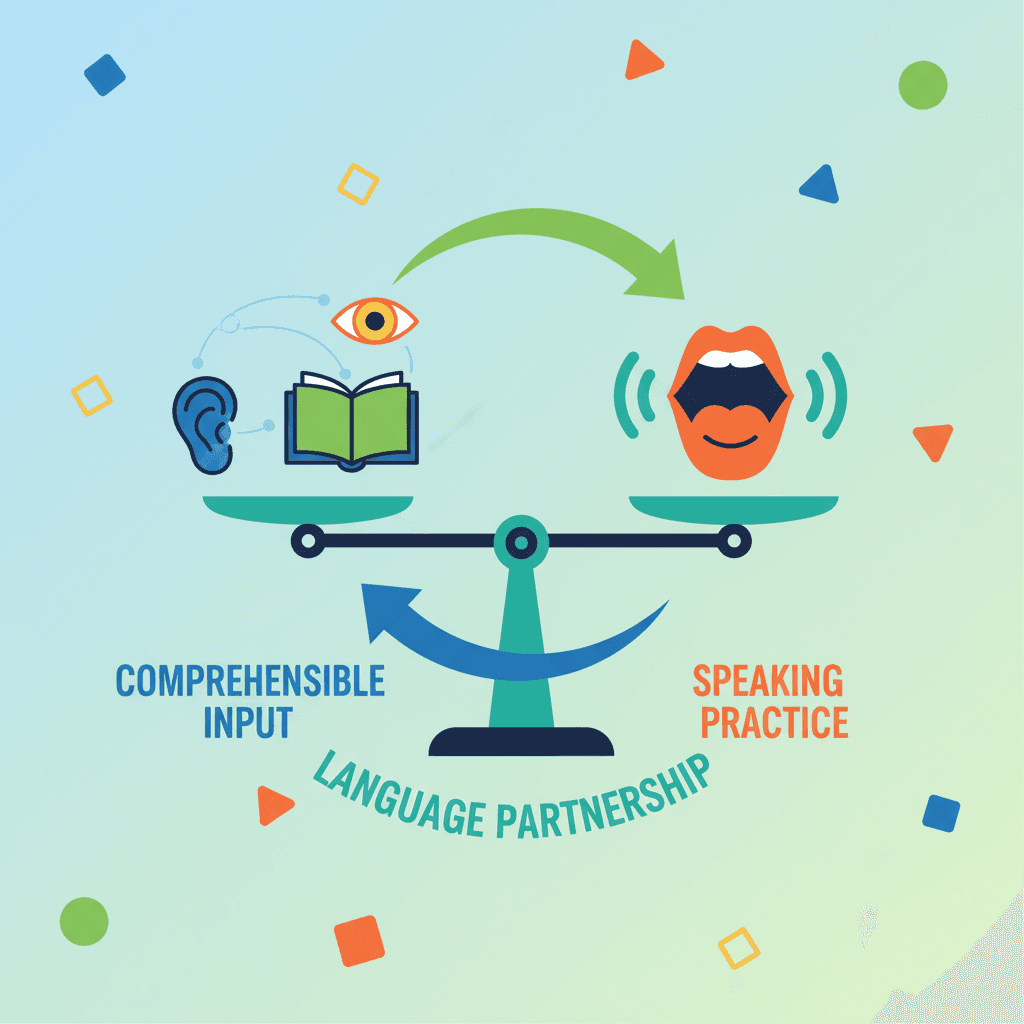
You’ve spent hours listening to podcasts and watching shows in your target language. You can follow the plot, understand the jokes, and recognize hundreds of words. But when you try to speak, the words get stuck. If this sounds familiar, you’ve stumbled into one of the biggest debates in language learning: comprehensible input vs speaking practice. Many learners treat these as opposing forces, but what if they’re actually two sides of the same coin? Modern language learning theory suggests a balanced approach is most effective, viewing them as essential partners that work hand-in-hand. Forget the 'vs.' — the key to unlocking fluent, confident speech is learning how to make input and output work together in a powerful, synergistic loop.
Why It’s Not Input vs. Output, It’s a Partnership
For years, language learners have been told to pick a side. One camp champions massive amounts of comprehensible input, suggesting you can absorb a language just by listening and reading. The other camp pushes for speaking from day one, believing that practice is the only way to produce speech. The truth? They’re both right. Relying solely on input often leads to a common frustration known as ‘input-output asymmetry,’ where your ability to understand the language far outpaces your ability to speak it. You build a huge mental library of words and phrases, but you haven't practiced checking them out.
Think of it this way: Input builds the library, and output teaches you how to find the books. According to summaries of classroom research, learners show significantly stronger vocabulary recall when words appear in understood passages compared to isolated word lists (MeloLingua, 2026). This is the power of input—it stocks your shelves with knowledge. However, as recent linguistic research emphasizes, 'Output is the purpose of input, and input is constrained by output' (The Impact of Input and Output Hypothesis, 2025). When you try to speak (output), you’re forced to actively search your mental library. This process helps you notice gaps in your knowledge, solidifying what you know and highlighting what you need to learn next.
Speaking practice, or output, plays a critical role by helping learners notice gaps in their linguistic knowledge, a function that complements the knowledge gained through input to build overall competence.
What is Comprehensible Input? (Your Language Foundation)
At the heart of the input-first philosophy is Dr. Stephen Krashen's influential Input Hypothesis. The idea is simple yet profound: we acquire language when we understand messages. This isn't about painstakingly dissecting grammar rules or memorizing flashcards. It's about receiving 'comprehensible input'—language that you can mostly understand through context, even if you don't know every single word.
Krashen described the ideal level of input as 'i+1', where 'i' is your current language level and '+1' represents new language that is just slightly beyond your grasp. By understanding the surrounding context, you can figure out the meaning of the '+1' material. This is how we all learned our first language as children. We weren't handed grammar textbooks; we were immersed in messages we could understand.
- •Graded Readers: Books written specifically for language learners at different levels.
- •Slow-Paced Podcasts: Podcasts designed for learners, often with transcripts.
- •TV Shows with Subtitles: Watching shows with subtitles in your target language helps connect spoken words to their written form.
- •YouTube Channels for Learners: Many creators produce content with clear speech and visual aids.
Why Input Alone Leads to the 'Intermediate Plateau'
If comprehensible input is so powerful, why can't we just listen our way to fluency? Because understanding is a passive skill, while speaking is an active one. Many learners who focus exclusively on input eventually hit the dreaded 'intermediate plateau.' They can understand movies and follow conversations, but their own speech is slow, hesitant, and full of errors. This is because input builds passive knowledge (recognition), but it doesn't automatically build active skills (recall and production).
Merrill Swain's 'Comprehensible Output Hypothesis' provides the other half of the equation. Swain argued that when we are forced to produce language—to speak or write—we engage with it on a much deeper level. The act of trying to form a sentence makes you move from simply understanding meaning (semantic processing) to constructing correct grammar (syntactic processing). This is where the magic happens. You might realize you don't know the right word, or you're unsure which verb tense to use. This 'noticing' is a crucial learning moment that input alone doesn't provide.
Trying to learn to speak a language only by consuming input is like trying to learn piano only by watching concerts. Speaking is a physical motor skill that requires practice to coordinate your brain, mouth, and breath.
Without this push to produce language, you risk falling into 'analysis paralysis,' constantly waiting until you feel 'ready' to speak—a day that may never come. Practicing output is what turns your passive vocabulary into an active one you can use on demand.
A Practical Plan to Balance Input and Speaking Practice
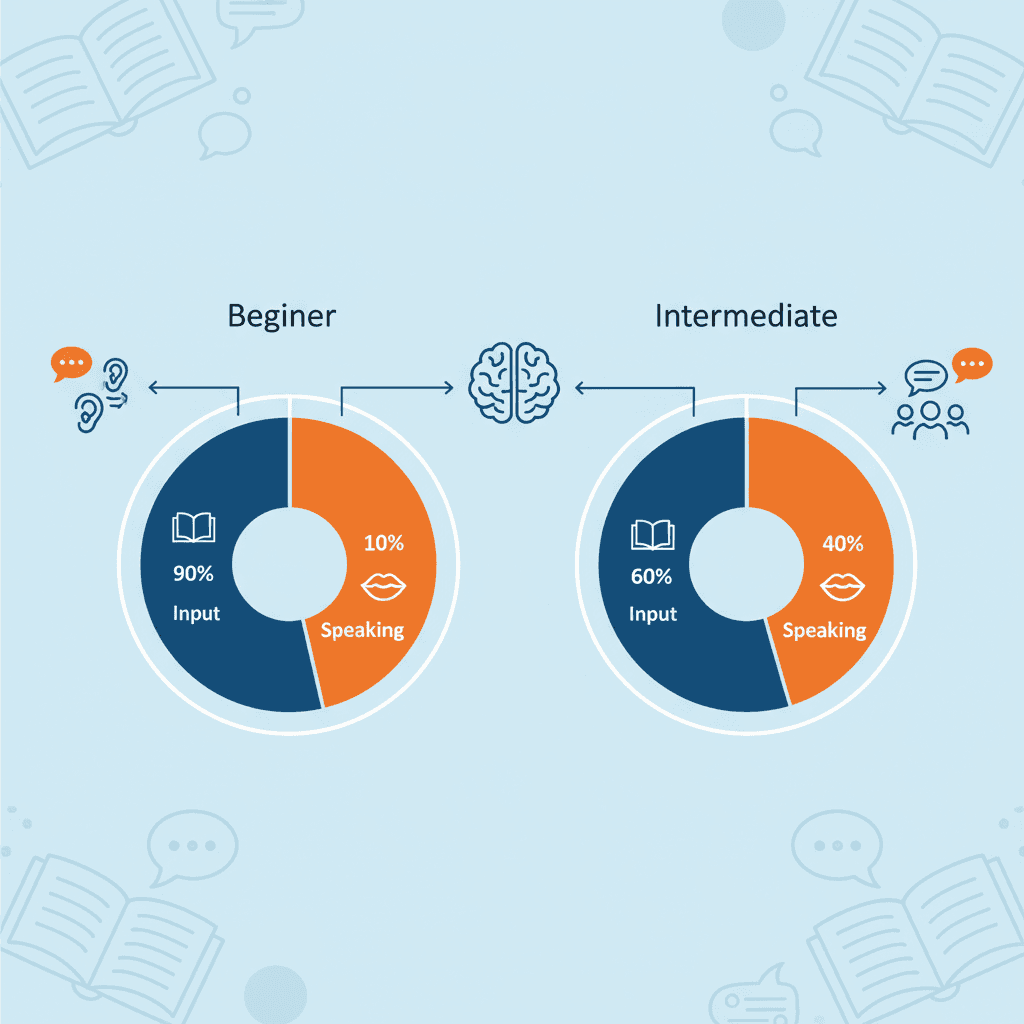
So, what's the right balance? How do you create a routine that leverages both the library-building power of input and the skill-building function of output? While there's no single magic number, many experts suggest a version of the '80/20 rule,' dedicating about 80% of your time to input and 20% to output. However, this ratio should evolve as you progress. Your goal is to build a solid foundation with input, then gradually increase your speaking practice to activate that knowledge.
Here’s a simple, progressive framework you can adapt to your weekly routine, whether you're in the US, UK, Australia, or anywhere else in the world. This plan is designed to build your skills and your confidence at the same time.
For Beginners (A1-A2): The 90/10 Rule
At the beginning of your journey, your primary focus should be on building a foundation. You need massive amounts of comprehensible input to start recognizing the sounds, rhythm, and basic structures of the language. A 2023 study by Beniko Mason and Nobuyoshi Ae found that just 70 hours of comprehensible input produced results comparable to 286 hours of traditional instruction—that’s how efficient it is.
- •Input Focus (90% of your time): Spend your time with graded readers, simple podcasts for learners, and children's cartoons. Your goal is to find material where you understand 95-98% of what's being said. This high level of comprehension is what allows for effortless acquisition.
- •Output Practice (10% of your time): Don't pressure yourself to have full conversations. Use this time for low-stakes practice like shadowing (repeating phrases after a native speaker), practicing the pronunciation of single words, and reading sentences aloud. This builds muscle memory without the cognitive load of creating sentences from scratch.
For Intermediates (B1-B2): The 60/40 Rule
Once you have a solid foundation, it's time to start activating your passive knowledge. As an intermediate learner, your goal is to bridge the gap between understanding and speaking. This means shifting your balance to include more deliberate output. Experts recommend a split closer to 60% input and 40% output. A 2026 comparison highlighted this, finding that users of platforms with more conversational practice reported faster improvements in speaking confidence (The Education Magazine, 2026).
- •Input Focus (60%): You can now tackle more native content, especially on topics you're familiar with. Watch YouTubers you like, listen to music with lyrics, and read news articles. Aim for material that is 90-98% familiar to keep it comprehensible but challenging.
- •Output Practice (40%): It's time to ramp up your speaking. Start with structured self-talk, describing your day or summarizing a podcast you listened to. Engage in low-stakes conversations, perhaps by leaving voice notes for a language partner or using an AI language tutor to answer questions and practice role-playing scenarios.
How an AI Tutor Creates the Perfect Learning Loop
The challenge for many learners is finding a safe, consistent, and effective way to practice output. This is where modern technology provides a perfect solution. An AI language tutor like the one offered at SpeaksyAI (speaksyai.com) is designed to create the ideal learning loop that combines comprehensible input with immediate output.
Here’s how it works: The AI asks you a question. That question serves as a perfectly tailored piece of comprehensible input. Then, you are immediately prompted to respond. This is your output practice. You’re not just passively consuming; you’re actively retrieving vocabulary and constructing sentences. Because the environment is private and non-judgmental, you can practice without the fear of making mistakes in front of a real person. This creates a powerful cycle: input -> output -> feedback -> confidence.
Advanced AI tutors can even remember your mistakes and adapt their questions to help you improve, creating a personalized curriculum in real-time. With 24/7 availability, you have a patient conversation partner ready whenever you have a spare 10 minutes, making it easier than ever to integrate the speaking practice needed to truly activate passive vocabulary and speak with confidence.
Frequently Asked Questions
Frequently Asked Questions
Ready to Balance Input and Output?
Stop wondering and start speaking. SpeaksyAI gives you a safe space to practice speaking with an AI tutor who's always available. Turn your passive knowledge into confident conversation.
Join the Waitlist