Break the Intermediate Language Plateau: A Diagnostic System
Feeling stuck at the intermediate level is frustrating but normal. This guide helps you diagnose *why* you've hit a plateau and gives you a system to break through it.

You’re Not Stuck, You’re Transitioning

You’ve done the hard work. You’ve moved past the beginner phrases, you can hold a simple conversation, and you can understand the gist of what’s going on around you. But now, progress has slowed to a crawl. You feel stuck, like you’re treading water in a sea of intermediate grammar and vocabulary. This feeling is frustrating, but here’s the good news: you’re not failing. You’re just experiencing the most common, predictable, and conquerable stage of language learning. This guide will show you how to get out of the intermediate language plateau by using a simple ‘Diagnostic and Activation System’ designed to pinpoint your exact problem and give you a clear action plan.
This slowdown isn't a sign of weakness; it’s a well-documented phenomenon in second language acquisition, first studied extensively by linguists Gass and Selinker (2001). The “intermediate plateau,” or “B1 plateau,” is a structural challenge, not just a motivational one. In fact, research suggests that a majority of learners who reach this stage do not progress beyond it without a deliberate change in strategy (Lingo7). Why? Because the skills that got you to the intermediate level are not the same skills that will get you through it.
The primary reason for this slowdown is the shift from learning general, high-frequency words to needing topic-specific fluency. To move from a B1 to an advanced level, you may need to as much as triple your existing vocabulary, focusing on less frequent words and more nuanced expressions. This requires a new approach: building expertise one subject at a time and, most importantly, turning your passive knowledge into active, confident speech.

Step 1: Diagnose Your Plateau (A 2-Minute Self-Test)
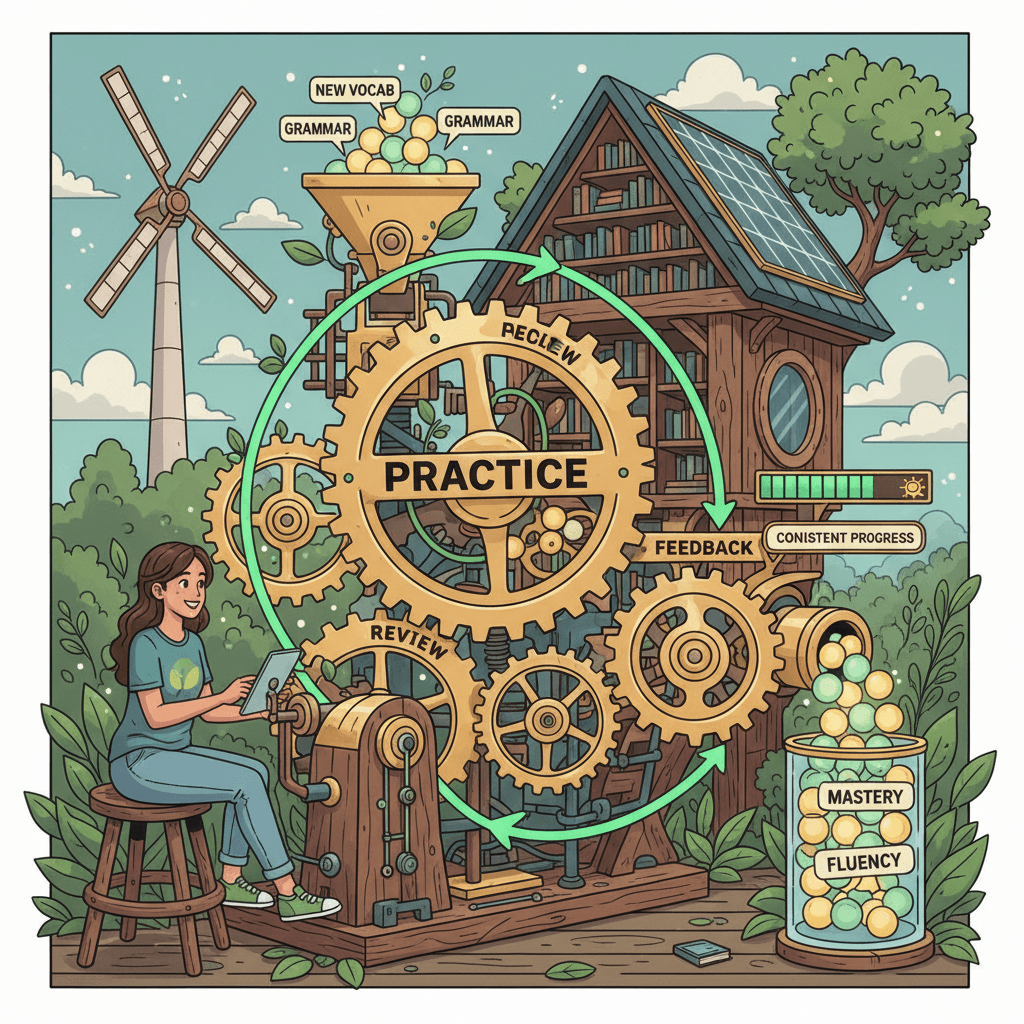
Before you can break through the plateau, you need to know what kind of plateau it is. An estimated 80% of language learners quit before reaching fluency, with most stopping right where you are now (Medium, 2026). Identifying your specific challenge is the most important step you can take to make sure you're not one of them. Ask yourself which of these three descriptions sounds the most like your current situation. Being honest here is your first win.
- •The Knowledge Hoarder: You have a massive passive vocabulary. You can read an article or watch a show and understand roughly 70% of it, enough to survive but not enough to truly own the conversation (Migaku, 2026). The problem is, when it’s your turn to speak, the words just aren't there. Your mental library is full, but you can’t check any of the books out.
- •The Hesitant Speaker: You know the grammar and you have the vocabulary, but the fear of making a mistake is paralyzing. You might rehearse sentences in your head but say nothing. The thought of speaking feels high-stakes and stressful, so you avoid it, which only reinforces the fear.
- •The Grammar Fossil: You speak, but you find yourself making the same ingrained mistakes over and over—with verb tenses, prepositions, or gendered nouns. This is called the 'fossilization of errors,' where mistakes become permanent habits despite you often knowing the correct rule. You feel like your grammar is permanently stuck in intermediate level.
Do you see yourself in one of those profiles? Excellent. That self-awareness is powerful. Now that you’ve diagnosed the issue, you can apply a targeted activation plan to start making progress again today.
Step 2: Your Activation Plan - The Knowledge Hoarder
If you’re a Knowledge Hoarder, your brain is packed with passive knowledge. The goal isn’t to learn more; it’s to activate what you already know. The most effective way to do this is to shift your focus from passive input (listening, reading) to active output (speaking, writing). This shift forces your brain to retrieve and use the words and sentence structures that you currently only recognize.
Instead of just listening to a podcast, try to summarize the main argument out loud in 60 seconds. Instead of just reading a news article, write a short paragraph with your opinion on the topic. This practice of retrieval is the key to converting passive vocabulary into a tool you can use spontaneously in conversation.
- 1.Adopt the Summary Technique. After watching a video or reading a chapter, pause and summarize it out loud. Don't aim for perfection; aim for production. The act of forcing yourself to speak is the workout.
- 2.Play the 'Explain It Like I'm 5' Game. Pick a topic you know well—your job, your favorite sport, a hobby—and try to explain it in your target language. This pushes you to use specialized vocabulary you've likely absorbed but never used.
- 3.Find a Judgment-Free Practice Zone. To experiment with new words, you need a safe space. This is where AI tutors are transforming language learning. They provide a low-stakes environment to practice speaking without the fear of being judged or misunderstood, which research identifies as critical for building confidence.
This activation-focused practice is exactly what modern language tools are built for. Platforms like SpeaksyAI (speaksyai.com) are designed to be your personal speaking gym. You can practice summarizing articles, role-playing conversations, or just describing your day, all while receiving helpful feedback in a completely private, 'judgment-free' environment. It's the perfect way to build the muscle memory you need to improve speaking skills.
Step 3: Your Activation Plan - The Hesitant Speaker
For the Hesitant Speaker, the plateau is less about knowledge and more about psychology. The fear of sounding foolish is a powerful barrier. The solution is to lower the stakes and make speaking a small, consistent, and non-negotiable daily habit. You need to prove to your brain that speaking is safe.
Forget the vague goal of 'speaking more.' Instead, language coaches recommend setting measurable 'micro-goals' to make output feel achievable (Fluent Show, 2026). A micro-goal is a tiny, specific speaking task that takes less than a minute to complete. The purpose isn't to have a long conversation, but to simply open your mouth and produce the language. This builds the habit of output.
- •Tell a 3-sentence story about your breakfast.
- •Describe a single object on your desk in detail.
- •Look at a photo and ask one question about it out loud.
- •Read one sentence from a book and say it back in your own words.
Practicing these tiny habits with an AI tutor can be incredibly effective. It allows you to build the all-important habit of daily output without the pressure of a live conversation partner. This strategy of balancing low-stakes AI practice to build foundational confidence before engaging in higher-stakes human conversations is a key trend for achieving fluency (Migaku, 2026). It systematically dismantles the fear and makes speaking feel normal, not terrifying.
Step 4: Your Activation Plan - The Grammar Fossil
If you're a Grammar Fossil, you're likely frustrated because you *know* the rules, but the wrong words keep coming out. This phenomenon of 'fossilization,' where persistent errors become permanent, is a primary cause of the intermediate plateau (Gass & Selinker, 2001). To fix this, you need a more surgical approach than just 'more conversation.'
The key is to identify, isolate, and drill. General practice won't work because your brain will default to the fossilized habit. You need to consciously target your specific recurring mistakes with immediate, corrective feedback. This is something modern AI tools are exceptionally good at, providing the real-time grammar correction needed to break old habits (Medium, 2026).
- 1.Identify Your Top 1-2 Errors. Don't try to fix everything. Are you constantly mixing up *ser* and *estar* in Spanish? Or forgetting the right preposition in English? Pick one major issue to focus on for a week.
- 2.Create Targeted Drills. Write down 10 sentences that force you to use the correct grammar point. Say them out loud. Then say them again tomorrow. You are creating a new neural pathway to compete with the fossilized one.
- 3.Use a Tool with Instant Feedback. An AI tutor can act as your grammar coach, catching your specific mistake every time you make it in a conversation. This instant feedback loop is crucial. A human partner might be too polite to correct you repeatedly, but an AI has no such reservations, making it the perfect tool for rewiring these deep-seated errors.
This targeted grammar work, often discussed among advanced learners, is essential for anyone wondering how to get past intermediate Spanish, French, or any other language with complex rules. It's not about learning new theory; it's about enforcing correct practice until it becomes the new habit.
Building a New System for Consistent Progress
Your diagnostic profile and activation plan are your tools to break the logjam. Now, let’s build the system that keeps the river flowing. Remember, the intermediate plateau is a structural challenge so common that most learners get stuck there permanently without changing their learning system (Lingo7). Your new system should be built on purpose and specificity.
First, evolve from passive immersion to purposeful immersion. Don’t just watch a Netflix show; watch it like a detective. Your mission is to hunt for specific linguistic clues. This aligns with expert advice to use native content to target specific vocabulary and grammar weaknesses (Lingo7). Instead of letting the language wash over you, engage with it actively.
- •While watching a show, listen for how characters agree or disagree. Write down 3-4 phrases they use and practice them.
- •While reading a book, highlight 10 words you understand but would never use yourself. Make it your mission to use three of them in a conversation with your AI tutor.
- •While listening to a podcast, focus on transition phrases the host uses to move between topics. These are the building blocks of fluid, natural speech.
Second, set new, advanced micro-goals that focus on function, not just knowledge (Duolingo Blog). Instead of a goal like 'learn 20 new words,' set a goal like 'learn 5 ways to express polite disagreement.' Or 'practice telling a story using the past tense.' This focus on practical communication is what will ultimately lead you to how to reach language fluency. This challenge is so prevalent that major platforms are racing to serve this exact need, with Busuu's revenue forecasted to grow 20% by 2025 and Duolingo targeting 100 million daily active users by 2028 partly by expanding into higher-level content.
FAQ: Getting Out of the Intermediate Plateau
Frequently Asked Questions
Ready to Break Your Plateau and Speak Confidently?
Get personalized feedback and targeted conversation practice with the SpeaksyAI language tutor. Join our waitlist for early access.
Join the Waitlist