The B1 to B2 Speaking System: A 12-Week Activation Plan
Stuck at the B1 intermediate plateau? This guide provides a step-by-step system to break through, helping you learn how to get from B1 to B2 speaking.

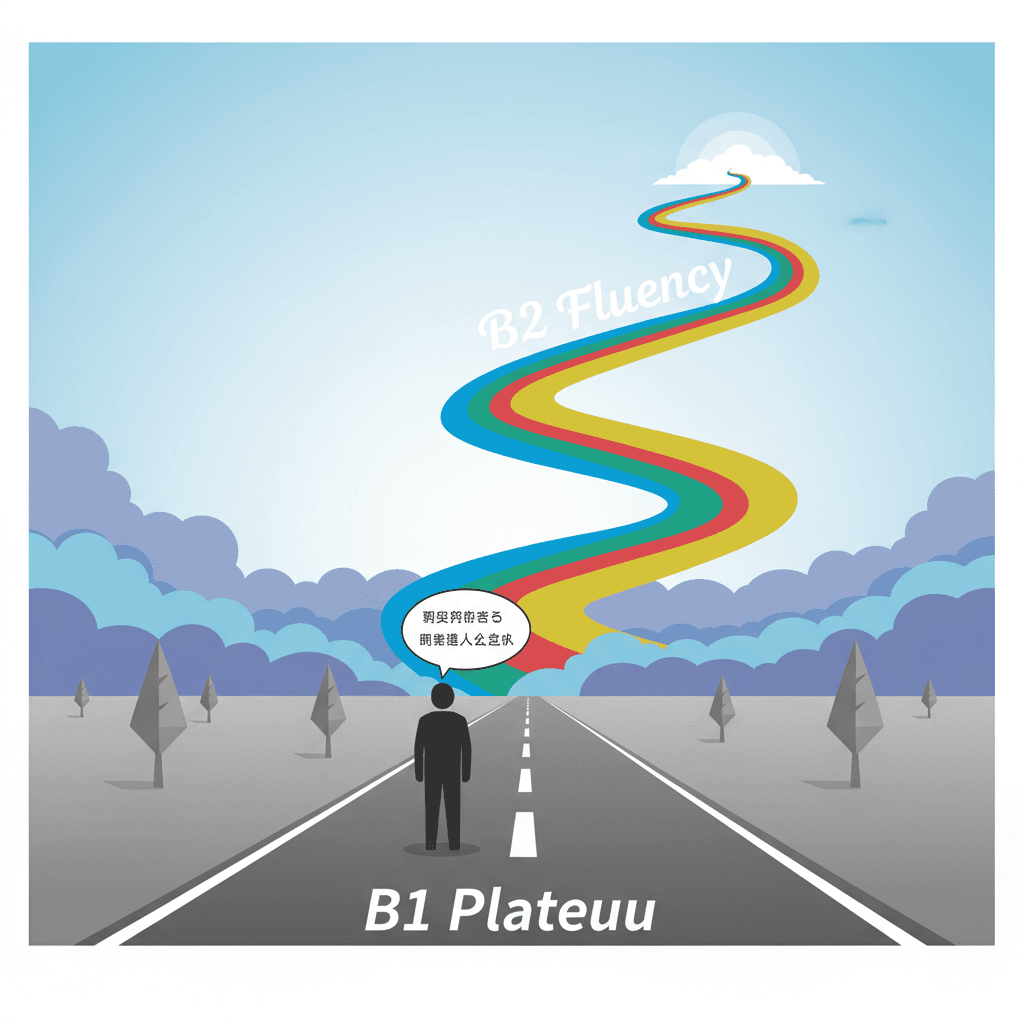
Why You're Stuck at the B1 Speaking Plateau (And How to Break Free)
Feeling like your language learning has hit a wall? You can handle daily conversations, order coffee, and talk about your weekend, but when it comes to expressing a complex opinion or joining a fast-moving debate, you freeze. This is the B1 speaking plateau, and it's one of the most common frustrations for learners. You're past the beginner stage, but you're not yet fluent. The good news is that breaking through isn't about random tips; it's about a clear, structured approach. This guide will walk you through our three-step ‘B1 to B2 Activation System,’ a proven method for understanding how to get from b1 to b2 speaking by moving from just ‘getting by’ to engaging deeply and confidently.
The journey from B1 (Intermediate) to B2 (Upper-Intermediate) is less about learning new words and more about learning how to use what you know with greater complexity and automaticity. Research from CEFRhub (2026) suggests this transition requires an estimated 200-300 hours of focused, structured learning. The plateau often happens because your passive vocabulary (words you recognize) is far larger than your active vocabulary (words you can use spontaneously in conversation), a gap noted by language experts (Medium, 2025). This is often compounded by a psychological barrier: a fear of making mistakes that discourages you from experimenting with the complex grammar and nuanced vocabulary that define B2-level communication.
Step 1: Diagnose Your B1 Bottleneck
Before you can build, you need to know where the cracks are. The first step in our Activation System is to diagnose exactly what’s holding you back. For many B1 speakers, the primary bottleneck is the gap between passive understanding and active production; you can follow a complex argument on a podcast but struggle to create one yourself. Advancing to B2 requires a fundamental shift from simple narration to higher-level skills like analyzing, comparing, arguing, and persuading on complex topics (B1 to B2 in 12 Weeks Guide, 2026). Without identifying your specific limiter, your practice hours won't be as effective.
Is it a lack of vocabulary for abstract topics? An inability to deploy the grammar you’ve studied? Or is it about fluency and discourse management—the ability to maintain a clear train of thought during longer speaking turns? One of the most common bottlenecks is becoming too comfortable with your current abilities. Overcoming this requires targeted effort. A great way to self-diagnose is to record yourself speaking on an unfamiliar topic for two minutes. When you listen back, you'll start to notice patterns of filler word overuse, simple sentence structures, or frequent pauses—all key areas where objective feedback can pinpoint your weaknesses.
What's Your Primary Limiter: Vocabulary, Grammar, or Fluency?
Take a moment for an honest self-assessment. Which of these common B1 challenges resonates most with you? Pinpointing your main obstacle is the key to targeted, effective practice.
- •Vocabulary Gap: You have a large 'reactive' vocabulary (words you understand) but a much smaller 'productive' one (words you use). You often struggle to find the right words for abstract topics like technology's impact on society or environmental policy. (CEFRhub, 2026)
- •Grammar Deployment Problem: You’ve studied conditionals and complex tenses, but in spontaneous conversation, you default to simple sentence structures. You *know* the grammar, but you fail to use it when it counts. (CEFRhub, 2026)
- •Fluency and Flow Issues: You find yourself mentally translating from your native language, leading to frequent pauses and hesitations. A 2026 study found this affects over 82% of learners at this stage. (ResearchGate, 2026)
- •Confidence Barrier: A fear of making mistakes is your biggest challenge, directly impacting your willingness to speak and experiment with new language. You're not alone—a study found 83.5% of students report this as a primary hurdle. (ResearchGate, 2026)
Using an AI Language Tutor for an Honest Assessment
Our self-perception can be unreliable. We either overestimate our abilities or are too critical. This is where an AI language tutor like SpeaksyAI becomes an invaluable tool. A May 2026 report from Test Prep Insight highlights that modern AI tutors can hold genuine conversations and provide instant, objective feedback. They act as an unbiased mirror, showing you how your speaking skills truly measure up against B2 standards.
The transition from B1 to B2 is defined by bridging the 'complexity and automaticity gap.' An AI tutor provides an honest assessment of this by analyzing your sentence structures, use of discourse markers, and conversational flow—not just counting your vocabulary. With 200-300 hours of targeted learning required for this leap (CEFRhub, 2026), using an AI tool for instant feedback on your grammar, pronunciation, and vocabulary range ensures every minute of your practice is spent effectively on your diagnosed weaknesses.
Step 2: Master B2 Speaking Functions, Not Just Words
Stop memorizing vocabulary lists. The key to unlocking B2 is shifting your focus from *what you know* to *what you can do* with the language. B2 speakers can navigate complex social and professional situations because they have mastered specific language functions. They don't just state facts; they persuade, speculate, and defend their opinions with nuance.
According to Cambridge research, those 200-300 guided learning hours are most effective when they are focused on practicing these functional skills (Fluentmood, 2026). A critical shift from B1 to B2 is moving beyond simple description to being able to analyze, compare, argue, and persuade on a variety of topics (B1 to B2 in 12 Weeks: Student Roadmap, 2026). This means practicing how to develop a clear argument spontaneously, a significant step up from the more prepared speech typical of the B1 level.
Exercise: Expressing Nuance and Defending Opinions
Let's put this into practice. The ability to argue a position and weigh alternatives is a cornerstone of B2 speaking. Instead of just stating an opinion, you need to be able to back it up, consider counter-arguments, and use nuanced language.
- 1.Pick a Debate Topic: Choose a question with two clear sides. For example: 'Is social media more harmful than good?' or 'Should all employees have the right to work remotely?'
- 2.Structure Your Argument: Use a simple framework like PEEL (Point, Evidence, Explain, Link) to organize your thoughts. State your main point, provide an example or evidence, explain why it matters, and link it back to your overall argument.
- 3.Practice Aloud: Set a timer for two minutes and record yourself defending your position. Don't worry about perfection; focus on maintaining your train of thought.
- 4.Simulate a Discussion: Practice with a language partner or use an AI role-play tool to simulate a debate. This forces you to think on your feet and respond to counter-points, a crucial B2 speaking practice.
To sound more nuanced, incorporate phrases to soften opinions, like 'I tend to think that...' or 'From my perspective...'. For polite disagreement, try 'I see your point, but have you considered...' or 'I'm not sure I see it that way.'
Exercise: Discussing Hypothetical & Abstract Topics
A key differentiator for B2 proficiency is the ability to move beyond concrete, everyday topics to discuss abstract or hypothetical scenarios (TEFL-TESOL-Certification.com, 2025). This skill requires confidence with more complex grammatical structures, particularly conditionals ('if... then' sentences).
The required 200-300 hours of structured learning must include significant practice with these structures (CEFRhub, 2026). Try this exercise: take a 'what if' prompt and speak for 90 seconds. Don't just give a one-sentence answer; explore the consequences and your reasoning. For example: 'What if you could live in any country for one year, all expenses paid? Which would you choose and why?'
Step 3: Implement Your 12-Week Activation Plan
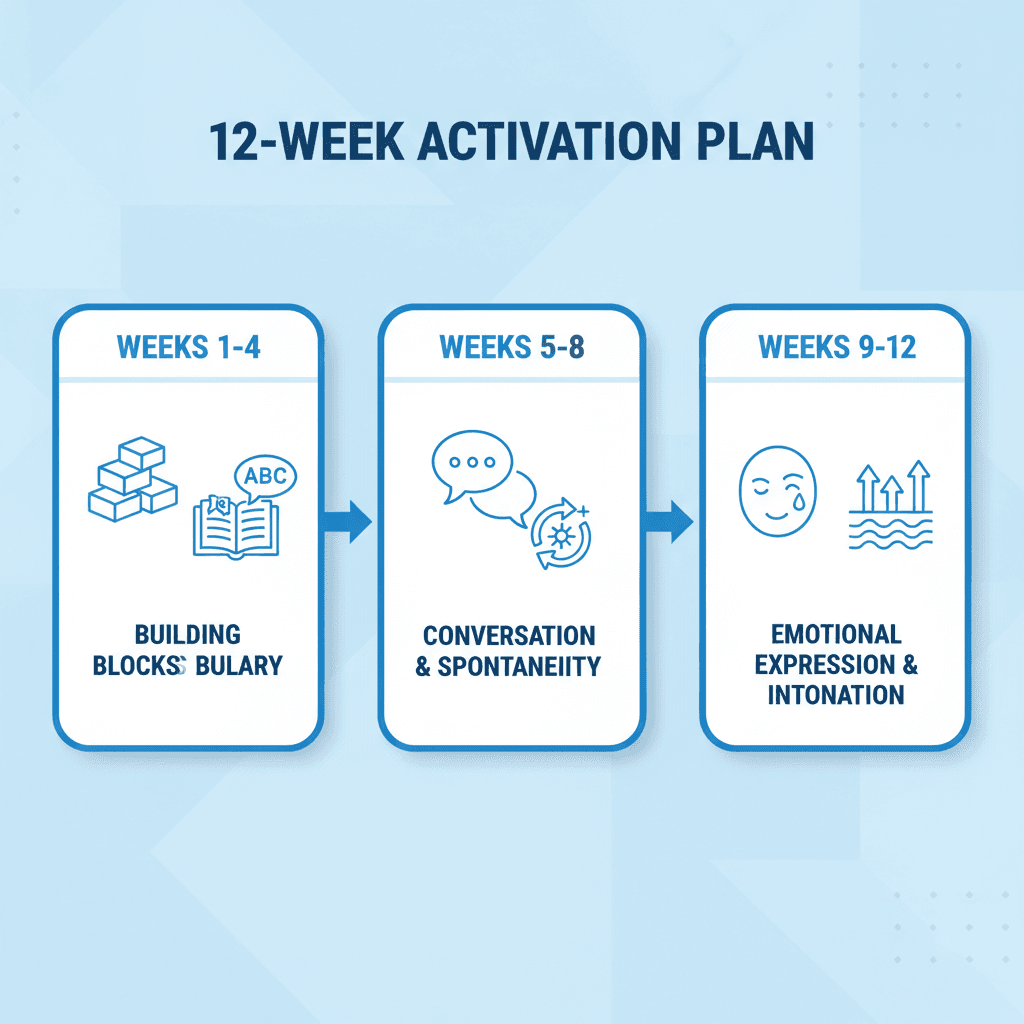
That goal of 200-300 hours of focused learning can feel daunting. But breaking it down into a structured 12-week plan makes it achievable. This plan is designed to build momentum by focusing on specific skills each month, layering complexity as you go. Remember, consistency is more important than intensity. A focused hour every day is far more effective than cramming for seven hours on a Sunday.
Research shows that with an intensive immersion of over 30 hours per week, a learner could potentially reach B2 from B1 in just 2-3 months (Fluentmood, 2026). In contrast, practicing for only one hour per day without a clear structure can extend that journey to 18-24 months (2026 Guide). This 12-week plan provides the structure to make your intensive effort count.
Weeks 1-4: Building Complexity & Active Vocabulary
The focus for your first month is on upgrading the foundation of your speech. It's about increasing the 'complexity and automaticity' of your sentences (CEFR 2020 Companion Volume). Your goal is to make using discourse markers and connecting ideas second nature.
- •Goal: Stop speaking in simple, choppy sentences and start connecting your ideas fluently.
- •Daily Task (15-20 mins): The 'Sentence Upgrade'. Take a simple B1-level sentence and rewrite it into a more complex B2-level thought. For example: B1: 'I think technology is good. It helps people.' -> B2: 'From my perspective, technology is overwhelmingly beneficial, primarily because it empowers individuals by providing access to information and resources.'
- •Key Phrases to Master: Actively learn and use linking words in your daily practice. Start with: 'Consequently,', 'Nevertheless,', 'On the other hand,', 'In addition to that...'
Weeks 5-8: Practicing Spontaneity & Extended Speech
Now that you're building more complex sentences, the next step is to practice producing them spontaneously and for longer periods. The primary challenge in advancing from B1 to B2 is learning to manage longer conversational turns and structure your thoughts quickly (B1 to B2 in 12 Weeks Student Roadmap, 2026). This phase is all about building your speaking stamina.
- •Goal: To speak confidently for 1-2 minutes on a given topic without a script, organizing your thoughts on the fly.
- •Daily Task (15-20 mins): The '1-Minute Monologue'. Listen to a 5-minute podcast segment or news report. Afterwards, give a 1-minute oral summary of the main points. Record yourself to check for clarity, filler words, and flow.
- •Practice Tool: This is an excellent time to use an AI practice partner. Unscripted conversations with a tool like SpeaksyAI provide a safe space to practice speaking spontaneously while receiving instant, targeted feedback on your grammar and fluency.
Weeks 9-12: Developing Nuance & Natural Intonation
In the final month, the focus shifts to the finer points that make your speech sound natural and sophisticated. This includes using intonation to convey meaning, expressing degrees of certainty or doubt, and using language appropriate for the situation. Studies on utterance fluency show that as learners approach B2, they exhibit a faster speech tempo and fewer awkwardly placed silent pauses (2025 study).
- •Goal: To use pitch, stress, and intonation to express more than just the literal meaning of your words.
- •Daily Task (15-20 mins): Role-play situations requiring politeness or persuasion. For example, practice politely disagreeing with a friend's movie recommendation or persuading a colleague to help with a project. Pay attention to *how* you say it.
- •Listen & Mimic: Watch short clips of native speakers from the US, UK, Canada, or Australia. Notice how their pitch rises or falls when asking a question versus making a statement. Pause and mimic them. This helps internalize the natural rhythm of the language.
How SpeaksyAI Accelerates Your Journey to B2
The journey from B1 to B2 speaking requires 200-300 hours of structured learning, and making every hour count is essential. SpeaksyAI acts as your personal AI language tutor, designed specifically to accelerate this process. It maximizes your practice time by providing instant, personalized feedback on the core skills that matter for B2: fluency, grammatical complexity, vocabulary range, and pronunciation.
Instead of just guessing where you need to improve, our system helps you diagnose your B1 bottlenecks with precision. The B2 level requires you to analyze, argue, and persuade, not just describe (Student Roadmap Guide, 2026). SpeaksyAI’s interactive role-play scenarios—from debating social issues to summarizing complex articles—are designed to give you targeted practice in these exact functions, helping you build the confidence to handle any conversation.
By providing a safe, on-demand space to practice speaking without fear of judgment, you can finally overcome the confidence barrier that holds so many learners at the B1 plateau. You get the consistent daily speaking practice needed for immersion, combined with the intelligent feedback required for structured improvement. It's the smartest way to invest your time and finally speak with the authority and confidence of a B2-level speaker.
FAQ: Your B1 to B2 Speaking Questions Answered
Frequently Asked Questions
Ready to Activate Your B2 Speaking Skills?
Get personalized feedback and unlimited practice with an AI language tutor designed to get you to fluency faster.
Join the Waitlist