How to Use an AI Tutor for IELTS Speaking: The Complete System
Feeling nervous about the IELTS speaking test? Discover how an AI tutor can be your personal, non-judgmental practice partner to help you speak confidently.

Facing the IELTS speaking test can feel like preparing for a high-stakes performance. You have just 11-14 minutes to prove your English proficiency to a live examiner, and the pressure is immense. But what if you could rehearse endlessly with a partner who never gets tired, offers instant feedback, and never judges you? This is where learning how to use an AI tutor for IELTS speaking practice becomes a game-changer. It’s not just about practicing questions; it’s about building a rock-solid foundation of confidence that allows you to walk into your test and truly shine.
Why an AI Tutor is Your Secret Weapon for IELTS Speaking
The biggest hurdle for many IELTS candidates isn't their English ability—it's anxiety. The fear of making a mistake in front of an examiner can cause you to hesitate, forget words, and underperform. An AI tutor completely removes this fear. It provides a safe, private space where you can practice speaking freely. According to a 2026 survey from Elispeak, building confidence was the number one goal for nearly 27% of language learners using AI, proving just how important a low-pressure environment is for making progress. With an AI, you can attempt difficult topics, stumble over your words, and try again as many times as you need, all without an ounce of judgment.
Imagine getting corrections the second you make a mistake. That’s the power of AI pronunciation feedback and real-time analysis. Instead of waiting days for a teacher's notes, an AI tutor can instantly highlight grammatical errors, suggest better vocabulary, and analyze your fluency. This rapid feedback loop accelerates your learning dramatically. In fact, a landmark 2025 study by Speechful AI found that learners who received real-time corrections from AI improved their spoken fluency scores by an incredible 15% in just four weeks. This shows that consistent, instant feedback is one of the most effective ways to improve your IELTS speaking score.
This isn't just about feeling better; it’s about tangible results. AI-powered learning isn't a future concept—it's a proven method for success right now. A major 2025 meta-analysis covering 87 different studies discovered that students using AI learning tools consistently outperformed their peers by an average of 12.4%. For a test like the IELTS, where every half-band counts, that's a significant advantage. With speech recognition accuracy in leading language apps hitting 94% as of 2025, you can trust that the feedback you receive on your pronunciation and word choice is precise and reliable.
The 3-Part AI Practice System for the IELTS Speaking Test
To truly get the most out of your AI practice, you need a structured approach. Just diving in without a plan won't get you the score you need. That's why we've developed The SpeaksyAI System for IELTS Success—a clear, actionable method to practice all three parts of the speaking test. This system turns your AI tutor from a simple chatbot into a dedicated, 24/7 IELTS examiner, guiding you through each stage of the test so you know exactly what to expect on test day.
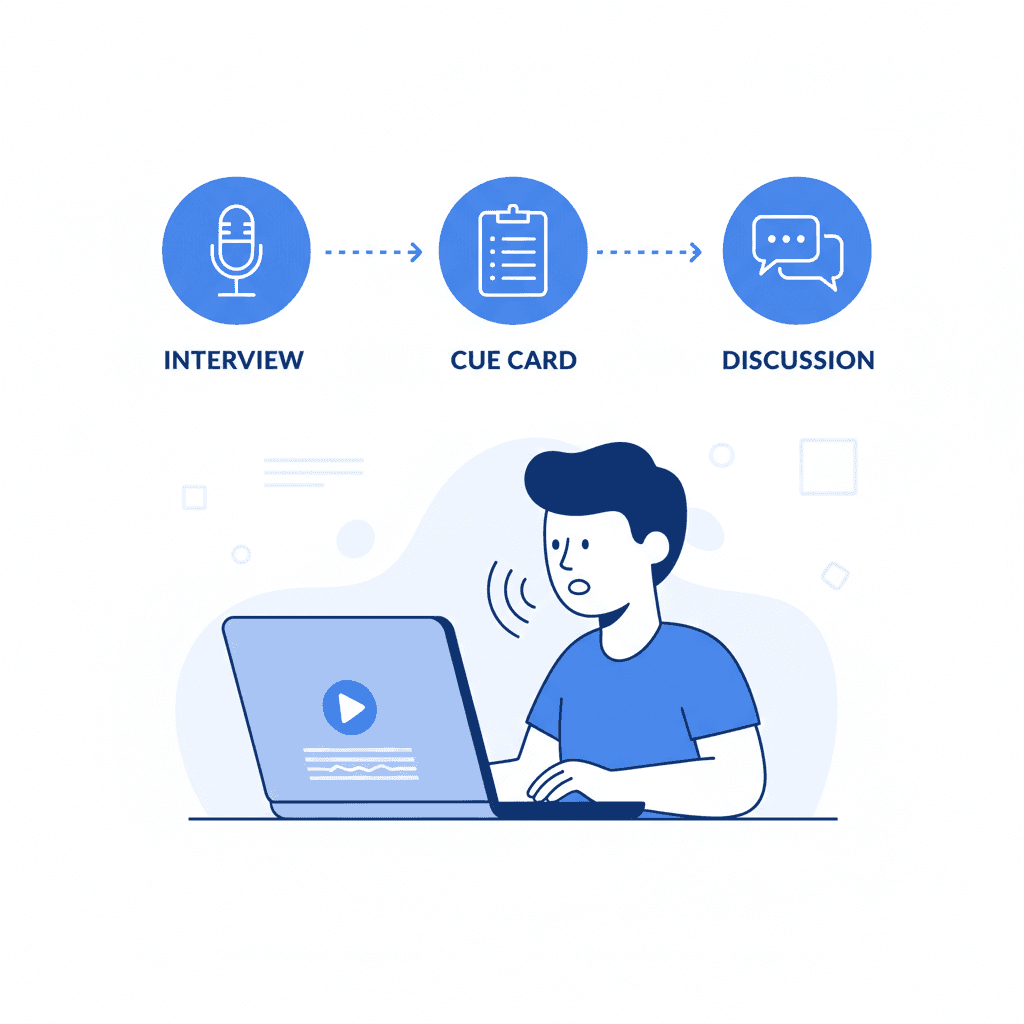
The core of this system is simulating the entire 3-part structure of the IELTS speaking test and analyzing your performance against the four official band descriptors. An advanced AI can be instructed to act as an examiner, asking you questions for Part 1 (Interview), giving you a cue card for Part 2 (Long Turn), and engaging you in a discussion for Part 3. The magic happens when you record your responses and have the AI analyze the transcript against the official criteria:
- •Fluency and Coherence: How smoothly and logically you speak.
- •Lexical Resource: The range and accuracy of your vocabulary.
- •Grammatical Range and Accuracy: Your ability to use a variety of grammatical structures correctly.
- •Pronunciation: How clearly and naturally you speak.
By practicing this way, you're not just answering questions—you're actively training the specific skills that examiners are grading you on. This targeted practice is crucial for anyone looking for effective IELTS speaking practice online. According to EnglishWise, this simulation helps dramatically reduce test-day nerves because it provides a non-judgmental space to get comfortable speaking aloud and receiving objective feedback. You build muscle memory for the test format, which frees up your mental energy to focus on expressing your ideas clearly and confidently.
Part 1: Simulating the Introduction and Interview
Part 1 of the IELTS speaking test is a 4-5 minute warm-up where the examiner asks you general questions about familiar topics like your home, family, work, studies, and interests. The goal here is to sound natural and confident. An AI tutor is perfect for this, as it can ask you an endless variety of questions on these common topics, helping you get comfortable speaking about yourself.
To start, you just need to give your AI tutor the right instructions. Be specific about the role you want it to play and the kind of feedback you need. Use a prompt like this to begin your session:
Act as an IELTS examiner for Speaking Part 1. Ask me 3-4 questions about a common topic like my hometown, my work, or my hobbies. After I respond to each question, provide feedback on my Fluency, Vocabulary (Lexical Resource), and Grammar.This prompt immediately sets up a realistic practice scenario. You can cycle through different topics in each session to prepare for whatever the examiner might ask. Common Part 1 topics include:
- •Work and/or Studies
- •Hometown
- •Home and Accommodation
- •Hobbies and Interests
- •Music and Films
- •Travel
Part 2: Mastering the 'Long Turn' Cue Card
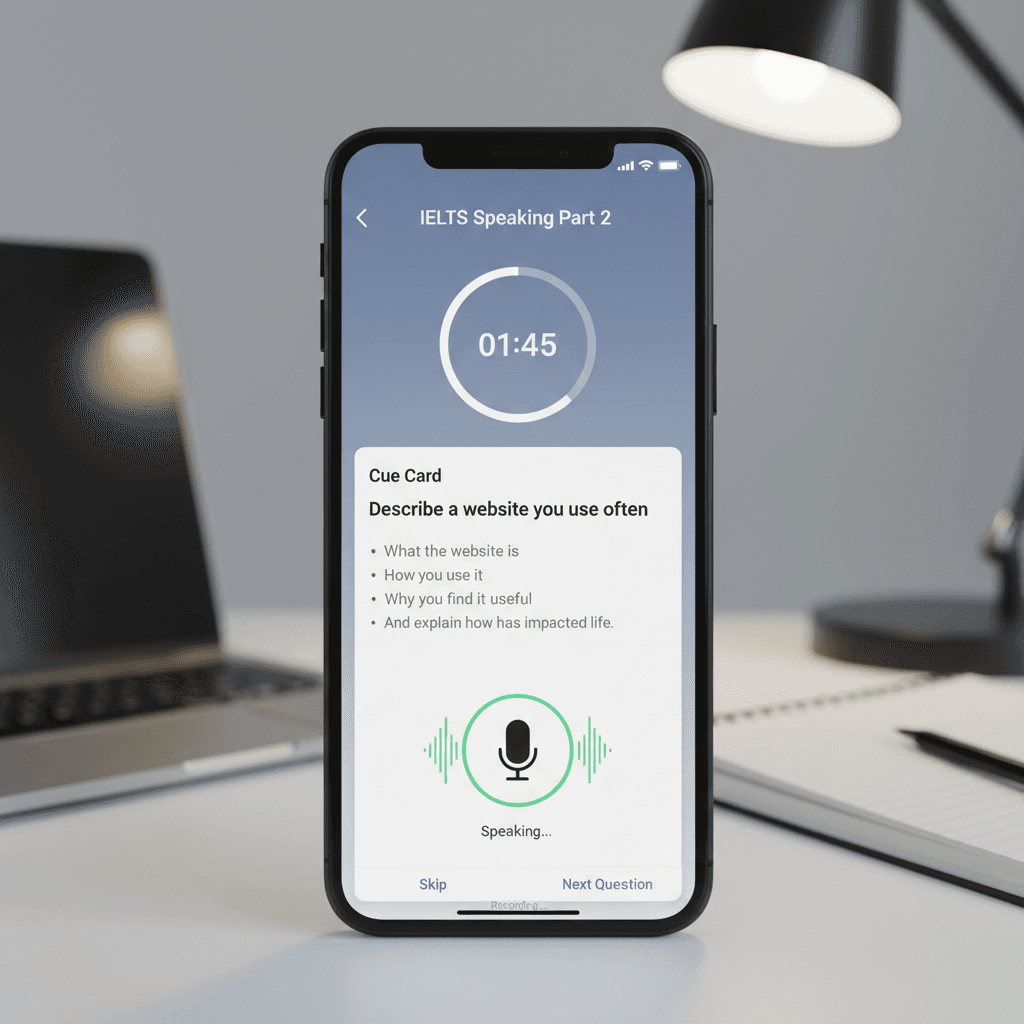
Part 2, often called the 'long turn,' is where many candidates feel the most pressure. You're given a cue card with a topic and some points to cover. You have one minute to prepare and must then speak for 1-2 minutes. This tests your ability to organize your thoughts and speak at length. Using AI for IELTS speaking is incredibly effective here for building the stamina and structure required.
You can instruct your AI tutor to act as your examiner for Part 2, providing you with a topic, timing your response, and giving detailed feedback. This is a crucial part of any IELTS speaking mock test AI. Here’s a powerful prompt to use:
Give me an IELTS Speaking Part 2 cue card on the topic of 'a memorable journey.' I will take one minute to prepare my thoughts. After my prep time, I will speak for two minutes. Please time me. When I'm done, analyze my response against the four official IELTS criteria and suggest how I could improve my structure and vocabulary.Just 20-30 minutes of daily AI practice for 60 days can accumulate 20-30 hours of focused speaking practice, helping to build the stamina needed for the Part 2 monologue.
Practicing with different cue cards is essential. Ask your AI to generate topics for you, such as 'Describe a skill you would like to learn,' 'Describe a person you admire,' or 'Describe an important event in your life.' According to a 2026 analysis by Vertex AI Search, this kind of practice leads to measurable improvements in pronunciation accuracy and increased speaking time—both critical for hitting that 2-minute mark with confidence.
Part 3: Navigating the Two-Way Discussion
Part 3 is a 4-5 minute discussion related to the topic from Part 2. However, the questions are more abstract and complex. This part tests your ability to express and justify opinions, analyze, and speculate. It requires you to 'think while speaking,' which is a skill that needs dedicated practice. Many students look for IELTS speaking topics practice specifically for this challenging section.
An AI tutor excels at simulating this back-and-forth discussion because it can generate spontaneous follow-up questions based on your responses. This pushes you beyond memorized answers and helps you develop the flexibility needed for a real conversation. Use this prompt to transition your practice session to Part 3:
Now, let's move to Part 3. Based on our Part 2 topic, ask me more abstract, discussion-style questions. Explore the broader impact of this topic on society and individuals. Please ask me follow-up questions based on my answers to create a realistic, two-way discussion.A 2025 study by Karatay & Xu demonstrated that a GPT-4o powered system could successfully simulate a Part 3 discussion, eliciting a wide range of interactive language from users. This confirms that AI is an excellent tool for standardizing practice for this abstract part of the test. As official questions trend towards complex topics like AI ethics and global tourism, practicing these two-way discussions is more important than ever to help you improve your IELTS speaking score.
Turning AI Feedback into a Higher Band Score
Receiving feedback is only half the battle; the real progress comes from understanding and acting on it. The best AI tutors, including platforms like SpeaksyAI (at speaksyai.com), don't just tell you what's wrong—they align their feedback with the four official IELTS scoring criteria. Here’s how to interpret that feedback to make targeted improvements.
- 1.Fluency & Coherence: The AI will flag hesitations, repetitions, and overuse of filler words (like 'um' or 'ah'). A 2026 study by BridgeTalk AI confirmed that AI excels at this. Your action: Rerecord your answer, focusing on speaking at a steady pace and using transition words (e.g., 'however,' 'furthermore') to connect your ideas smoothly.
- 2.Lexical Resource (Vocabulary): The AI can suggest more sophisticated or precise words. A study involving the AI 'Call Annie' showed that learners made significant vocabulary gains. Your action: Don't just read the suggestions. Pick three new words and actively try to use them in your next practice response.
- 3.Grammatical Range & Accuracy: AI is fantastic at spotting recurring errors, like incorrect verb tenses or article usage. Your action: If the AI consistently points out tense mistakes, dedicate a practice session just to telling a story in the past, present, and future. Ask the AI to only check for that one error.
- 4.Pronunciation: Advanced AI can now perform phoneme-level analysis, giving you incredibly detailed feedback. Your action: Isolate words the AI flags. Use the AI's audio playback feature to listen to the correct pronunciation, then record yourself saying the word until you get it right.
This systematic approach of practice, feedback, and targeted re-practice is what drives real improvement. Remember the stat from Speechful AI: learners who received and acted on real-time AI corrections saw their spoken fluency jump by 15% in just a month. That's the power of actionable feedback.
Building Your Weekly AI-Powered IELTS Study Plan
Consistency is far more powerful than cramming. A structured weekly plan will keep you on track and ensure you cover all the necessary skills. A 2026 survey by Elispeak revealed that 41.3% of successful AI tutor users aim for a manageable 20 minutes of daily practice. This is an excellent target to build a habit around. The goal is to make your IELTS speaking practice online a regular part of your routine.
Here is a sample weekly schedule you can adapt. This plan ensures you dedicate time to each part of the test and, most importantly, to reviewing your feedback.
- •Monday (20 mins): Part 1 Practice. Focus on sounding natural and fluent. Use the AI prompt for Part 1 and ask for feedback on your use of filler words.
- •Tuesday (20 mins): Part 2 Practice. Focus on structure and vocabulary. Do one full cue card response, then ask the AI for 5 better 'band 7+' words you could have used.
- •Wednesday (20 mins): Part 3 Practice. Focus on developing your arguments. Have a 10-minute discussion with the AI, then spend 10 minutes reviewing the transcript for grammatical accuracy.
- •Thursday (20 mins): Pronunciation Drill. Reread one of your previous responses. Ask the AI to provide specific, phoneme-level AI pronunciation feedback.
- •Friday (15 mins): Full Mock Test. Run through a complete Part 1, 2, and 3 simulation with your AI examiner to build stamina and practice transitions.
- •Saturday (30 mins): Review & Consolidate. Go over all the feedback from the week. Identify one major weakness and create a specific goal for the following week.
- •Sunday: Rest. Let your brain absorb the information. Watch a movie or listen to a podcast in English from the US, UK, Australia, or Canada.
Sticking to a schedule like this delivers results. Studies from AI English Tutor in 2026 show that this level of consistent practice can lead to a 0.5–1.0 band score improvement in just 4 to 8 weeks. Every small, daily session adds up to a huge leap in confidence and competence.
The Limitations of AI (And How to Overcome Them)
To use a tool effectively, you must also understand its limits. AI is an incredibly powerful practice partner, but it's not a perfect human examiner. Being aware of its weaknesses allows you to create a well-rounded study plan that uses AI for what it does best while supplementing it with other methods.
One key limitation is an AI's understanding of cultural nuance and advanced idiomatic language. An AI's knowledge is based on its training data, and as a 2026 Forbes article noted, data quality can be a barrier to understanding subtle human communication. It might not always catch that you've used an idiom perfectly or slightly incorrectly in a way a native speaker from the UK or Australia would instantly recognize.
Over-reliance on AI tutors can lead to 'skill erosion,' where a learner's critical thinking and ability to self-correct may deteriorate from excessive dependence on the tool.
To get the best of both worlds, think of your AI tutor as your daily training partner and supplement it with other activities. Here’s how to overcome the limitations:
- •Combine AI with Human Feedback: Use your AI for daily fluency and grammar practice, but try to have a weekly or bi-weekly chat with a human tutor or language exchange partner who can give you feedback on style and nuance.
- •Consume Authentic Content: Watch English movies, listen to podcasts, and read articles. This exposes you to natural language, culture, and idioms that AI might miss.
- •Use AI to Practice, Not to Cheat: Never ask an AI to write an answer for you to memorize. Use it to generate ideas or model structures, but always respond with your own thoughts.
- •Become Your Own Critic: Before you ask the AI for feedback, try to analyze your own response. What do you think you did well? Where did you struggle? This prevents 'skill erosion' and keeps your critical thinking sharp.
FAQ: Your AI & IELTS Questions Answered
Frequently Asked Questions
Ready to Speak Confidently?
Get personalized feedback and practice anytime with an AI language tutor designed to help you prepare for your test.
Join the Waitlist